
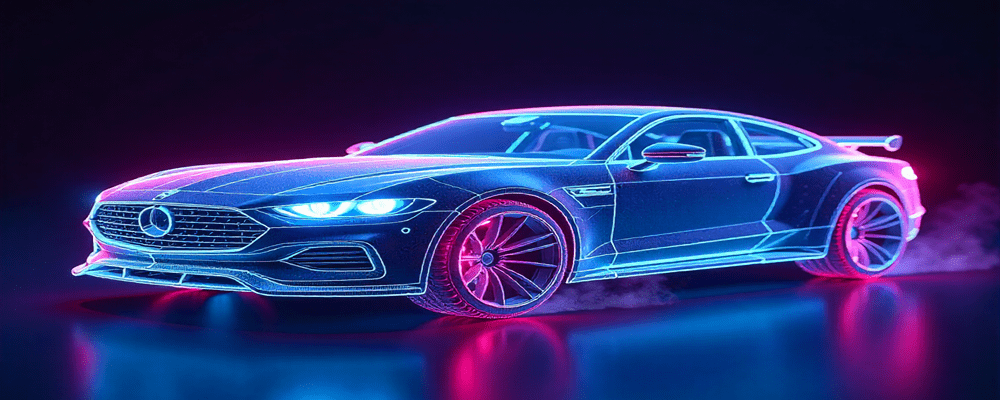
From Sketch to Showroom: How AI & XR Accelerate Vehicle Development
From Sketch to Showroom: How AI & XR Accelerate Vehicle Development
In the last decade, the automotive industry has undergone rapid technological transformation. But nothing has accelerated innovation as dramatically as the combined force of Artificial Intelligence (AI) and Extended Reality (XR). Together, these technologies are reshaping how vehicles are imagined, designed, tested, and launched – turning long, expensive workflows into fast, data-driven, collaborative experiences.
Today, the journey from initial sketch to showroom-ready vehicle does not depend on endless physical prototypes, repetitive testing cycles, or siloed engineering teams. Instead, automotive companies are embracing AI – powered XR solutions to reduce development costs, shorten R&D timelines, and improve design accuracy at every stage.
In this blog, we’ll explore how AI + XR are revolutionizing automotive R&D, why leading manufacturers are making the shift, and how these technologies are helping brands go to market faster than ever.
The Traditional R&D Cycle: Slow, Expensive, and Fragmented
Before we understand the impact of AI and XR, it’s important to look at the bottlenecks in traditional automotive R&D:
- Designing and approving concepts could take months.
- Physical prototypes were costly and time consuming to build.
- Testing required multiple iterations, each with its own prototype.
- Collaboration between designers, engineers, and decision-makers happened in stages, not in real time.
- Any late-stage design error increased costs dramatically.
This slow and linear workflow made innovation expensive and launch timelines unpredictable. But now, AI-driven XR is replacing outdated processes with faster, smarter, and more immersive development environments.
Where AI Meets XR: A Fast Lane for Automotive Innovation
AI enhances XR by adding intelligence, automation, prediction, and personalization to immersive environments. When combined, they create a complete ecosystem where teams can visualize, test, and refine vehicles at unprecedented speed.
Here’s how this powerful duo accelerates automotive R&D:
1. AI-Enhanced Concept Design: Faster Creativity, Better Decisions
Designers traditionally start with sketches and CAD models, but with AI:
- Visual concepts are generated in minutes using AI-powered design tools.
- Multiple design variations can be created instantly.
- The system predicts visual flaws or structural issues before going further.
When these designs are transferred into XR:
- Teams can walk around the model in a full-scale virtual environment.
- Designers can compare different design versions side-by-side.
- Immediate feedback reduces rework and speeds up approvals.
AI + XR cuts early design stages from months to weeks.
2. Virtual Prototyping: Test Hundreds of Versions Without Building One
Physical prototypes have always been expensive and limited. AI + XR transform this stage:
AI generates realistic simulations
Weather conditions, crash scenarios, durability tests, and user behavior can be simulated with high accuracy.
XR enables immersive testing
Teams experience the prototype in real scale, detecting issues that 2D screens cannot reveal.
Instant modifications
Engineers can tweak design or performance parameters in real time inside the XRenvironment.
Manufacturers can test three times more variations at a fraction of the cost.
3. Smart EngineeringwithReal-Time Collaboration
In conventional workflows, engineers review designs for one department at a time. AI + XR make this process collaborative.
How it works:
- The entire engineering team enters a shared XR environment.
- AI analyzes structural integrity, aerodynamics, materials, and energy efficiency.
- Engineers see real-time insights and suggested improvements.
- Cross-team decisions happen instantly, not over months.
This significantly reduces miscommunication, errors, and delays while improving product quality.
4. AI + XR for Predictive Testing and Simulation
If there’s one area where AI truly shines, it’s predictive capabilities. By integrating predictive analytics into XR testing:
- Engineers can foresee failures before they happen.
- AI recommends better materials or structural changes.
- Simulated road testing helps refine performance across terrains and weather.
- User experience studies become more accurate with behavioral prediction models.
Instead of reacting to issues, automotive teams prevent them saving millions in revisions.
5. Accelerating Manufacturing Readiness
The shift from prototype to manufacturing often causes delays. But with AI + XR:
Digital twins replicate the vehicle and assembly line
Teams visualize the exact manufacturing process in an XR environment – even before production begins.
AI identifies bottlenecks and inefficiencies
The system suggests better workflows, improved layouts, or safer procedures.
Workforce training becomes immersive
New technicians can practice assembling critical components in XR with AI guidance.
The result is faster production setup, fewer errors, and higher throughput.
6. Customer Previews and Market Testing Without Physical Models
Before launching a vehicle, brands often test consumer reactions. With AI + XR:
- Customers can preview cars in virtual showrooms anywhere in the world.
- AI collects feedback on color, design, comfort, and features.
- XR-enabled virtual test drives generate high-quality data.
This cuts the need for early physical prototypes while boosting marketing impact.
How AI + XR Dramatically Reduce Launch Timelines
Here’s a realistic breakdown of the improvements:
| R&D Stage | Traditional Timeline | With AI + XR |
| Concept Design | 3 – 6 months | Weeks |
| Prototype Development | 6 – 12 months | Days or weeks |
| Engineering Collaboration | 2 – 4 months | Real-time |
| Testing & Validation | 6 -10 months | Continuous in XR |
| Pre-Launch Market Testing | Many Months | Instantly in virtual environments |
Total vehicle development time can drop from 3 – 5 years to nearly 1 – 2 years.
This acceleration allows brands to stay ahead in a competitive market while reducing operational costs and improving overall product quality.
Why Automotive Leaders Are Prioritizing AI + XR in 2025 and Beyond
Here are the biggest reasons:
- Rise of electric vehicles (EVs)
- Growing demand for customized designs
- Need to reduce production costs
- Competitive pressure
- Sustainability goals
AI + XR are not optional, they are essential tools for modern automotive innovation.
Future of Automotive R&D: Fully Intelligent, Immersive, and Real-Time
By 2030, most automotive companies will rely heavily on a combination of:
- AI-powered generative design
- XR-driven immersive collaboration
- Digital twins for smart manufacturing
- Predictive analytics for performance optimization
- Virtual showrooms and remote customer experiences
These technologies will create a world where product ideas become market-ready vehicles faster than ever before.
Conclusion
The journey from sketch to showroom has always been complex but AI and XR have turned it into a faster, smarter, and efficient process. Automotive brands adopting these technologies today are gaining massive competitive advantages: reduced development time, lower costs, better collaboration, and superior product quality.
Sapizon Technologies delivers advanced AI + XR solutions that streamline vehicle design, accelerate prototyping, and enhance virtual testing. We help automotive brands reduce R&D time, improve efficiency, and go to market faster with intelligent immersive technologies.