
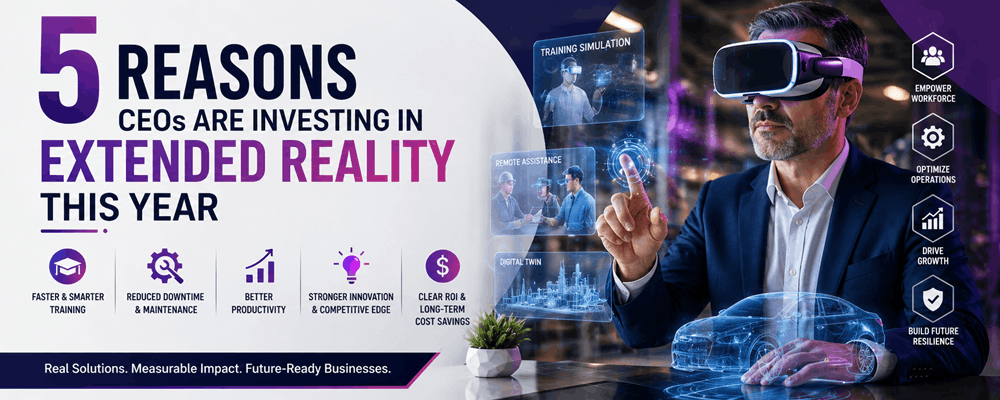
5 Reasons CEOs Are Investing in XR (Extended Reality) This Year
5 Reasons CEOs Are Investing in XR (Extended Reality) This Year
Business leaders today are under pressure to improve productivity, reduce costs, train employees faster, and stay ahead of competitors. Markets are moving quickly, customer expectations are changing frequently, and industries like manufacturing, automotive, logistics, healthcare, and retail are becoming more technology-driven every year. That is why many CEOs are now paying attention to Extended Reality. Instead of seeing it as just a futuristic trend, companies now view it as a practical business tool that can solve real operational problems.
From improving employee training to reducing machine downtime, this technology is helping businesses make smarter decisions and achieve better results. It combines digital experiences with the real world to create immersive and interactive solutions that improve the way people work.
In this blog, we will explore the top five reasons CEOs are investing in this technology this year and why it has become a serious business strategy.
What Is XR (Extended Reality)?
Extended Reality is a broad term used for immersive technologies such as Augmented Reality (AR), Virtual Reality (VR), and Mixed Reality (MR).
- AR adds digital information to the real world.
- VR creates a fully virtual environment.
- MR blends real and digital objects so they can interact.
These tools are now being used by businesses to train teams, support maintenance staff, improve design collaboration, and create better customer experiences.
1. Faster and Smarter Employee Training
Training is one of the biggest challenges for growing businesses. New employees need to learn quickly, while experienced teams need regular upskilling.
Traditional training methods often rely on classroom sessions, manuals, or shadowing senior staff. These methods can take time and may not always be effective.
With immersive learning tools, companies can create hands-on training experiences where employees practice tasks in realistic environments.
Why CEOs Like This
- Faster onboarding for new hires
- Better learning retention
- Lower training costs over time
- Safer practice environments
- Consistent training across locations
For example, a manufacturing company can train machine operators using virtual simulations before they ever touch real equipment. This reduces mistakes and builds confidence.
When training becomes faster and more effective, companies save time and improve workforce readiness.
2. Reduced Downtime and Faster Maintenance
Unexpected downtime can be expensive. A machine breakdown can slow production, delay deliveries, and impact revenue.
This is one reason business leaders are investing in digital support systems for maintenance teams.
Using AR-based guidance, technicians can view step-by-step repair instructions directly in their field of vision. They can also connect with remote experts who guide them in real time.
Benefits for CEOs
- Faster problem solving
- Reduced downtime costs
- Better first-time fix rates
- Less dependency on a few senior experts
- Improved operational continuity
For industries like automotive and manufacturing, even a small reduction in downtime can create major savings over the year.
This makes immersive support solutions more than a technology investment—it becomes a profitability strategy.
3. Better Productivity Across Operations
Every CEO wants more efficiency. If teams can complete tasks faster without reducing quality, the business becomes stronger.
Interactive digital tools help workers access instructions, checklists, visual guides, and live data while performing tasks. This reduces confusion and saves time.
Instead of stopping work to search for manuals or wait for help, employees can solve issues on the spot.
How Productivity Improves
- Fewer workflow interruptions
- Faster task completion
- Better accuracy
- Improved communication between teams
- Less rework and fewer mistakes
For example, warehouse workers can use smart visual systems for picking and packing. Assembly teams can use guided workflows to reduce errors.
Small efficiency gains across many departments can lead to major business improvements.
4. Stronger Innovation and Competitive Advantage
Markets reward companies that innovate early. CEOs know that businesses using modern tools often attract better talent, impress customers, and move faster than slower competitors.
Adopting immersive technologies signals that a company is forward-thinking and serious about digital transformation.
Why This Matters
- Stronger brand image
- Better customer confidence
- Easier attraction of skilled talent
- Faster product development
- Improved collaboration across teams
For example, design teams can review prototypes in virtual spaces before building physical models. This speeds up development and reduces waste.
Companies that modernize operations today are often the ones leading their industries tomorrow.
Many CEOs used to see immersive technology as expensive or experimental. That mindset is changing.
Today, business leaders are focusing on measurable outcomes such as:
- Lower training costs
- Reduced travel expenses
- Less downtime
- Faster design cycles
- Improved employee performance
- Fewer safety incidents
Once these results are measured, the return on investment becomes easier to justify.
Example ROI Areas
| Business Challenge | Possible Improvement |
| Slow onboarding | Faster training cycles |
| Machine downtime | Quicker repairs |
| Travel for expert support | Remote guidance |
| Product design delays | Virtual collaboration |
| Repetitive errors | Guided workflows |
When CEOs see real savings and operational gains, investment decisions become easier.
Why Manufacturing and Automotive CEOs Are Leading Adoption
Some industries are adopting these tools faster than others, especially manufacturing and automotive.
These sectors deal with:
- Complex machinery
- Skilled labor shortages
- Safety requirements
- High downtime costs
- Continuous training needs
- Global operations
Because of these challenges, immersive solutions provide immediate value.
A factory that improves maintenance response times or reduces training delays can quickly gain a financial advantage.
That is why many industrial leaders are making these tools part of their long-term strategy.
How to Start Without Big Risk
Many CEOs assume adoption requires huge budgets or complete digital transformation. That is not always true.
A smarter approach is to begin with one use case.
Best Starting Points
- Technician training
- Remote maintenance support
- Safety training
- Product design reviews
- Assembly guidance
Start small, measure results, and scale what works.
This reduces risk and gives leadership teams confidence before larger rollouts.
Common Mistakes CEOs Should Avoid
Even great technology can fail with poor planning.
Avoid These Mistakes
- Starting without clear business goals
- Buying hardware without a use case
- Ignoring employee adoption
- Not measuring ROI
- Choosing tools that cannot scale
The best results happen when technology is tied directly to business problems.
Why This Trend Is Growing This Year
Several factors are pushing adoption now:
- Pressure to improve efficiency
- Need for faster training
- Rising labor costs
- Remote collaboration needs
- Better hardware and software availability
- Stronger proof of ROI from real businesses
As tools become easier to use and more affordable, adoption is accelerating.
CEOs no longer ask, “What is this technology?”
They ask, “How fast can it help my business?”
How Sapizon Technologies Helps Businesses
Sapizon Technologies helps businesses adopt practical immersive solutions designed for real business outcomes.
Whether your goal is:
- Workforce training
- AR maintenance guidance
- Virtual product demos
- Manufacturing efficiency
- Automotive process improvement
- Custom enterprise solutions
Sapizon Technologies can help design and implement solutions based on your industry needs.
Instead of generic tools, businesses need solutions built around actual workflows and measurable returns.
Final Thoughts
CEOs invest in technology when it solves real problems, improves efficiency, and creates measurable value.
That is exactly why interest in Extended Reality is growing this year.
It helps companies train faster, reduce downtime, improve productivity, innovate sooner, and lower long-term costs.
The businesses that move early often gain the biggest advantage.
If your company is looking to modernize operations and stay ahead of competitors, now is the right time to explore practical use cases and start with a focused strategy.
FAQs
Is Extended Reality only for large companies?
No. Small and mid-sized businesses can also start with focused use cases like training or remote support.
Which industries benefit the most?
Manufacturing, automotive, healthcare, logistics, retail, education, and real estate are leading adopters.
Is it expensive to implement?
Costs vary, but many companies begin with pilot projects that deliver measurable ROI before scaling.
How long does implementation take?
Simple projects can begin quickly, while custom enterprise solutions may take longer depending on complexity.