
Reducing EV Battery Production Errors with XR (Extended Reality)
Reducing EV Battery Production Errors with XR (Extended Reality)
As the electric vehicle market continues to expand, manufacturers are under increasing pressure to produce high-quality batteries faster, safer, and more efficiently. Extended Reality (XR) is emerging as a powerful technology that helps manufacturers address one of their biggest challenges of production errors. From workforce training and assembly guidance to quality inspection and maintenance support, XR is transforming how EV battery production facilities operate. By reducing human errors and improving process accuracy, manufacturers can increase productivity, enhance safety, and maintain the high standards required in modern battery manufacturing.
The Growing Complexity of EV Battery Manufacturing
Electric vehicle batteries are among the most sophisticated components in the automotive industry. A battery pack consists of hundreds or even thousands of individual cells, along with sensors, connectors, cooling systems, wiring, and battery management components. Every part must be assembled correctly to ensure performance, reliability, and safety.
Unlike traditional manufacturing processes, EV battery production requires extremely high precision. Even a small mistake during assembly, inspection, or testing can lead to costly consequences.
Common production challenges include:
- Incorrect component placement
- Wiring and connection errors
- Missed quality inspection checkpoints
- Improper assembly sequences
- Human errors during manual operations
- Inconsistent employee training
- Production downtime caused by mistakes
- Rework and material waste
As production demand increases, these challenges become even more difficult to manage. Manufacturers need smarter solutions that help employees perform tasks accurately while maintaining production speed. This is where Extended Reality is proving valuable.
Understanding XR in Manufacturing
XR is a broad term that includes Virtual Reality (VR), Augmented Reality (AR), and Mixed Reality (MR).
Virtual Reality (VR): Virtual Reality creates fully immersive digital environments where employees can learn and practice manufacturing processes without affecting actual production equipment.
Augmented Reality (AR): Augmented Reality overlays digital instructions, visual guides, and real-time information onto physical equipment and workspaces.
Mixed Reality (MR): Mixed Reality blends digital and physical environments, allowing workers to interact with virtual objects while performing real-world tasks.
Together, these technologies provide a more effective way to train employees, guide operations, and improve production accuracy.
Why Production Errors Happen in EV Battery Manufacturing
Many production errors are not caused by negligence or lack of effort. Instead, they often occur because manufacturing processes are becoming increasingly complex.
Workers may face challenges such as:
- Learning new production procedures quickly
- Understanding detailed assembly instructions
- Managing multiple quality checkpoints
- Handling high-voltage battery components safely
- Adapting to frequent process updates
- Maintaining consistency across shifts
Traditional training methods often struggle to keep up with these demands. Employees may understand procedures theoretically but still make mistakes when performing tasks in real production environments.
Extended Reality helps bridge this gap by providing hands-on, interactive learning and operational support.
How Extended Reality Reduces EV Battery Production Errors
Immersive Workforce Training
Effective training is the foundation of error reduction.
Traditional training methods typically involve classroom sessions, manuals, videos, and supervised practice. While useful, these methods often lack the practical experience needed to build confidence and accuracy.
With Virtual Reality, employees can train in realistic simulations that replicate actual battery production environments.
They can practice:
- Battery cell assembly
- Module installation
- Wiring procedures
- Equipment operation
- Safety protocols
- Inspection workflows
Workers can repeat these tasks multiple times until they become comfortable with the process.
Since training takes place in a virtual environment, mistakes become learning opportunities rather than costly production errors.
As a result, employees enter the production floor better prepared and more confident.
Step-by-Step Assembly Guidance
Battery assembly often involves complex procedures that must be followed precisely.
Even experienced workers can occasionally miss a step, especially in fast-paced production environments.
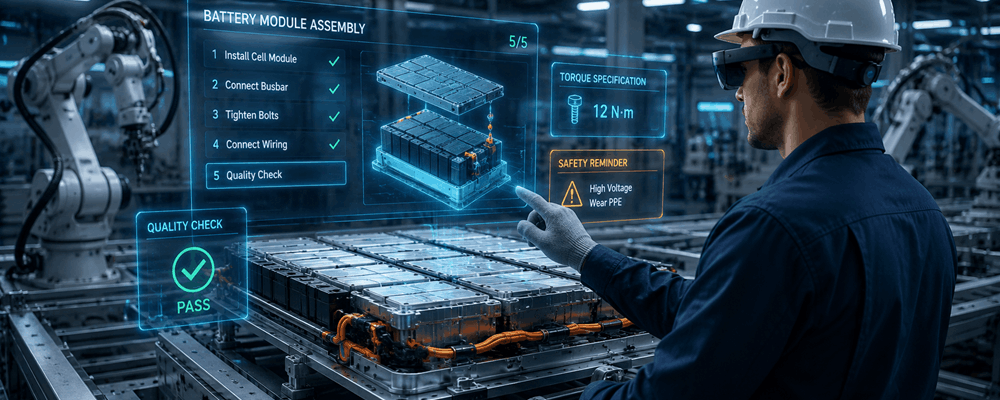
Augmented Reality provides workers with real-time visual instructions directly within their field of view.
Instead of referring to printed manuals or computer screens, employees can see:
- Assembly sequences
- Component locations
- Installation instructions
- Torque specifications
- Safety reminders
This reduces confusion and helps workers complete tasks correctly the first time.
Visual guidance also minimizes dependency on memory, which is a common source of production mistakes.
Improving Quality Inspection Accuracy
Quality control plays a critical role in EV battery manufacturing.
Inspectors must verify that every component has been assembled correctly and that all quality standards have been met.
Traditional inspection processes can be time-consuming and susceptible to human oversight.
Extended Reality enhances inspections by providing interactive checklists, visual overlays, and digital verification tools.
Inspectors can compare completed assemblies with digital models and identify deviations more efficiently.
Benefits include:
- Faster inspections
- Improved consistency
- Reduced inspection errors
- Better documentation
- Increased traceability
This helps manufacturers maintain high-quality standards while reducing costly defects.
Supporting New Employee Onboarding
The EV industry is experiencing rapid growth, creating a constant demand for skilled workers.
Training new employees quickly without compromising quality is a major challenge.
XR-based onboarding programs allow new hires to learn production processes through interactive simulations.
Instead of spending weeks observing others, employees gain hands-on experience in realistic virtual environments.
This accelerates learning while reducing the likelihood of mistakes during the early stages of employment.
Faster onboarding also helps manufacturers scale operations more efficiently.
Enhancing Safety During Battery Production
Safety is a critical concern in battery manufacturing.
Workers frequently handle high-voltage systems, sensitive materials, and specialized equipment.
Mistakes can create safety hazards that impact both employees and production facilities.
Virtual Reality allows workers to practice emergency procedures and safety protocols in realistic scenarios without exposing them to actual risks.
Employees can learn how to:
- Handle battery components safely
- Respond to equipment failures
- Follow emergency procedures
- Identify workplace hazards
- Use protective equipment correctly
Better safety training often leads to fewer operational mistakes and improved workplace confidence.
Reducing Rework and Material Waste
Production errors often result in rework, which consumes time, labor, and materials.
In battery manufacturing, rework can be particularly expensive because components are highly specialized and quality standards are extremely strict.
By providing employees with real-time guidance and better training, Extended Reality helps prevent errors before they occur.
Fewer mistakes lead to:
- Reduced material waste
- Lower production costs
- Faster production cycles
- Improved operational efficiency
- Higher product quality
Preventing errors at the source is significantly more cost-effective than correcting them later.
Remote Expert Assistance
When production issues arise, workers often require support from experienced engineers or technical specialists.
Traditionally, this may involve travel, production delays, or lengthy troubleshooting processes.
Mixed Reality enables remote experts to see what frontline workers are seeing and provide real-time guidance.
Experts can:
- View live production environments
- Identify problems remotely
- Share instructions visually
- Guide repairs and adjustments
This reduces downtime and helps workers resolve issues more quickly and accurately.
A Short Guide to Implementing Extended Reality in EV Battery Manufacturing
Organizations interested in adopting XR can follow a structured approach:
Step 1: Identify High-Error Processes
Analyze production data and identify areas where mistakes occur most frequently.
Examples may include:
- Battery assembly
- Wiring installation
- Quality inspections
- Equipment maintenance
Step 2: Define Clear Objectives
Establish measurable goals such as:
- Reducing assembly errors
- Improving training effectiveness
- Increasing inspection accuracy
- Shortening onboarding time
Step 3: Start with a Pilot Project
Begin with a specific use case rather than implementing XR across the entire facility.
This allows teams to evaluate results and refine processes before scaling.
Step 4: Train Employees
Provide employees with proper training on XR tools and workflows.
Successful adoption depends on user confidence and engagement.
Step 5: Measure Performance
Track key metrics such as:
- Error rates
- Training completion times
- Production efficiency
- Rework costs
- Safety incidents
Data-driven insights help demonstrate the value of XR investments.
The Future of EV Battery Manufacturing with Extended Reality
As electric vehicle adoption continues to grow, battery manufacturers will face increasing pressure to improve efficiency, quality, and scalability.
Extended Reality is expected to play a larger role in supporting smart manufacturing initiatives by integrating with technologies such as artificial intelligence, digital twins, automation, and industrial IoT systems.
Future XR applications may include:
- Real-time production monitoring
- Predictive maintenance support
- Advanced digital twin visualization
- AI-assisted worker guidance
- Fully immersive manufacturing simulations
These advancements will help manufacturers build more intelligent, connected, and efficient production environments.
Conclusion
Reducing production errors is one of the biggest priorities for EV battery manufacturers. As battery systems become more sophisticated and production demands continue to increase, relying solely on traditional training methods and manual processes is no longer enough. Extended Reality helps manufacturers improve workforce training, streamline assembly operations, enhance quality inspections, and reduce costly mistakes before they impact production.
By providing immersive learning experiences and real-time operational guidance, XR enables employees to perform complex tasks with greater accuracy, confidence, and efficiency. The result is improved product quality, lower operational costs, reduced rework, and a safer manufacturing environment.
At Sapizon Technologies, we help automotive and manufacturing organizations leverage the power of Extended Reality to solve real-world operational challenges. From immersive workforce training and virtual simulations to AR-powered assembly guidance and industrial XR solutions, our team develops customized experiences that improve productivity, reduce errors, and accelerate digital transformation initiatives.
Ready to Transform Your EV Battery Manufacturing Process?
If you’re looking to reduce production errors, improve workforce efficiency, and enhance manufacturing quality through Extended Reality, our experts can help.
Contact Sapizon Technologies today to discover how XR solutions can support your EV battery manufacturing operations and drive measurable business results.