
How Virtual Reality Is Transforming Submarine Manufacturing
How Virtual Reality Is Transforming Submarine Manufacturing
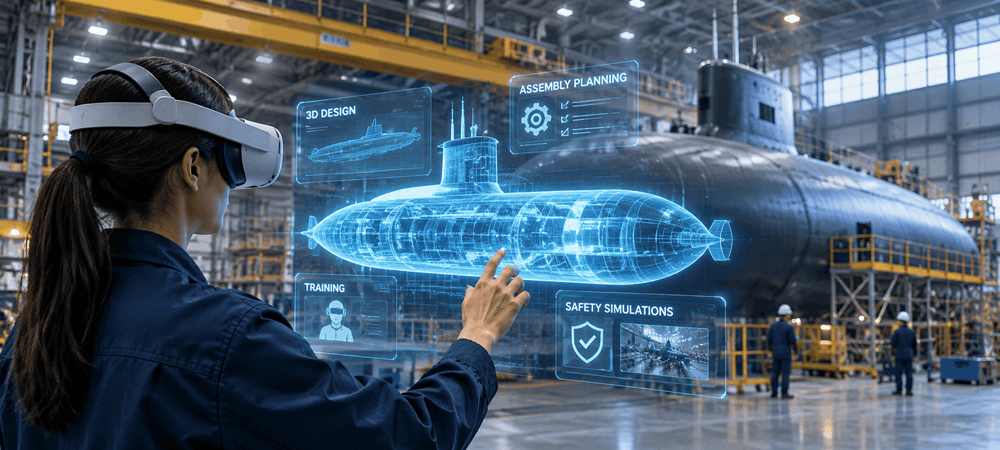
Submarine manufacturing is one of the most complex processes in the marine and defense industries. Building these advanced underwater vessels requires exceptional engineering precision, detailed planning, strict safety standards, and coordination between multiple teams. Virtual Reality (VR) in submarine manufacturing is emerging as an innovative solution that helps overcome these challenges by enabling engineers to visualize complex designs, simulate assembly procedures, and identify potential errors before physical production begins.
Traditional manufacturing methods often rely on technical drawings, physical prototypes, and hands-on training, which can be time-consuming and expensive. By integrating VR technology into manufacturing workflows, companies can explore submarine designs in immersive 3D environments, improve workforce training, and reduce avoidable rework. As the marine and defense industries continue to adopt advanced digital technologies, Virtual Reality offers new opportunities to improve manufacturing efficiency, engineering accuracy, and collaboration across teams.
What Is Virtual Reality in Submarine Manufacturing?
Virtual Reality is an immersive technology that creates a computer-generated 3D environment where users can explore and interact with digital models. Using VR headsets and specialized software, engineers can examine submarine structures, inspect equipment placement, and simulate manufacturing processes in a virtual space.
In submarine manufacturing, VR can be used to create detailed digital representations of submarine hulls, control rooms, engine compartments, electrical systems, and other critical components.
Instead of relying entirely on 2D drawings or physical mock-ups, teams can walk through a virtual submarine, identify potential design issues, and evaluate different configurations before manufacturing begins.
This approach helps bridge the gap between design, engineering, production, and training.
Key Benefits of Virtual Reality in Submarine Manufacturing
1. Improved Submarine Design and Visualization
Submarine designs involve complex structures, interconnected systems, and strict spatial requirements. Engineers must ensure that every component fits correctly within the available space.
VR allows design teams to explore full-scale 3D submarine models before building physical prototypes. They can examine internal compartments, visualize equipment arrangements, and understand how different systems interact.
For example, engineers can virtually inspect a machinery compartment to determine whether pumps, pipes, electrical panels, and maintenance access points are positioned appropriately.
Identifying design issues during the planning stage can reduce costly modifications during production.
2. Enhanced Assembly Planning
Submarine assembly requires careful coordination because many components must be installed in a specific sequence. Limited internal space can make certain installation tasks particularly challenging.
Virtual Reality enables manufacturing teams to simulate assembly procedures in advance. Workers can visualize how large components should be positioned, identify potential obstructions, and evaluate the sequence of installation.
VR-based assembly planning can help manufacturers:
- Identify component interference before physical assembly.
- Improve installation sequences.
- Evaluate access to difficult-to-reach areas.
- Reduce assembly errors and unnecessary rework.
- Improve coordination between engineering and production teams.
By rehearsing complex assembly activities virtually, teams can enter the production environment with a clearer understanding of the process.
3. Better Workforce Training and Skill Development
Submarine manufacturing requires highly skilled professionals who understand specialized equipment, technical procedures, and safety requirements.
However, training directly on complex machinery or an actual submarine may be expensive, difficult to organize, or unsuitable for beginners.
VR training creates a controlled virtual environment where employees can practice procedures and become familiar with equipment without interacting with operational systems.
For instance, technicians can learn the layout of an engine compartment, practice equipment inspection procedures, and understand component installation sequences through guided virtual simulations.
The major advantages include:
- Repeatable, hands-on learning experiences.
- A safe environment for practicing unfamiliar procedures.
- Better visualization of complex technical systems.
- Consistent training across teams and locations.
- Reduced dependence on physical training mock-ups for suitable learning tasks.
VR can complement traditional classroom instruction and practical training, helping employees build familiarity before performing real-world tasks.
4. Reduced Manufacturing Costs and Rework
Physical prototypes, design revisions, and assembly errors can increase the overall cost of submarine production.
Virtual Reality allows teams to evaluate designs and manufacturing procedures before committing to expensive physical changes.
By identifying potential issues early, manufacturers may reduce unnecessary prototype development, avoid some assembly mistakes, and improve resource utilization.
For example, if a component cannot be installed because of restricted access, engineers can identify the problem in a virtual assembly simulation and revise the design or installation sequence before production reaches that stage.
Although VR requires investment in software, hardware, and digital modeling, it can deliver long-term value when applied to suitable high-cost manufacturing processes.
5. Improved Maintenance Accessibility and Equipment Inspection
Submarines contain complex machinery and interconnected systems that may be difficult to access or inspect.
VR enables engineers to explore digital models of equipment compartments and evaluate whether technicians have sufficient space to perform inspection, servicing, and component replacement.
Maintenance teams can use virtual walkthroughs to understand equipment locations and plan procedures before entering restricted physical spaces.
For example, a virtual model can help evaluate whether a pump can be removed without obstructing nearby components or whether a maintenance panel provides sufficient working clearance.
When connected to accurate engineering data, VR can support better maintainability planning during the design stage rather than waiting for accessibility problems to emerge during actual maintenance.
6. Stronger Safety Awareness
Safety is a critical consideration in submarine manufacturing because workers may operate around heavy equipment, confined spaces, electrical systems, and complex assembly processes.
VR simulations can recreate selected manufacturing scenarios to help employees understand hazards and practice appropriate responses.
Training scenarios may include equipment-handling procedures, hazard identification, emergency evacuation principles, and safe movement through complex work areas.
Because the simulations are repeatable, instructors can assess employee understanding and provide feedback without exposing trainees to the corresponding physical hazards.
VR training should complement, rather than replace, required practical instruction, approved safety procedures, and supervised workplace training.
7. Better Collaboration Between Engineering Teams
Submarine manufacturing often involves collaboration between mechanical engineers, electrical engineers, designers, production specialists, and quality teams.
When teams rely on separate drawings and technical documents, understanding the complete design can become challenging.
A shared VR environment allows stakeholders to examine the same 3D model, discuss component placement, and identify potential conflicts before manufacturing begins.
Remote teams may also participate in virtual design reviews, reducing the need for some in-person meetings.
This approach can improve communication between departments and help decision-makers understand complex engineering concepts more clearly.
Real-World Applications of VR in Submarine Manufacturing
Virtual Reality can support multiple stages of the submarine manufacturing lifecycle.
1. Hull and compartment design: Engineers can explore internal layouts and assess spatial relationships between structural elements and equipment.
2. Equipment installation: Production teams can simulate the placement of machinery, piping, cable routes, and other components.
3. Control room visualization: Designers can review the arrangement of consoles, displays, seating, and operator workspaces to improve ergonomics and accessibility.
4. Manufacturing process simulation: Teams can rehearse selected assembly operations and evaluate alternative workflows before implementing them physically.
5. Technical training: Employees can learn component locations, equipment functions, and approved procedural sequences in an immersive environment.
6. Maintenance planning: Engineers can review access requirements and visualize how components might be inspected, serviced, or replaced.
The effectiveness of each application depends on the accuracy of the digital models, the quality of the simulation, and how well VR integrates with existing engineering systems.
Virtual Reality vs. Traditional Manufacturing Methods
Traditional manufacturing methods remain essential, but VR provides an additional way to evaluate designs and prepare teams before physical work begins.
| Traditional approach | VR-enabled approach |
| Primarily relies on drawings and physical models | Supports immersive 3D design visualization |
| Design issues may emerge during physical assembly | Some issues can be identified through virtual reviews |
| Training may require physical equipment or mock-ups | Selected procedures can be practiced in simulations |
| Design reviews may depend on 2D documents | Teams can explore models together in 3D |
| Assembly sequences may be reviewed manually | Installation workflows can be rehearsed virtually |
VR is not a complete replacement for conventional engineering methods. Instead, it enhances them by providing a more interactive way to visualize complex systems and evaluate decisions.
Challenges of Implementing VR in Submarine Manufacturing
Despite its advantages, implementing VR in submarine manufacturing requires careful planning.
High Initial Investment
Developing accurate 3D models, acquiring VR equipment, and integrating simulation software can require significant investment. Manufacturers should prioritize applications where improved design reviews, training, or assembly planning can justify the cost.
Accurate Digital Models
VR simulations are only as reliable as the underlying models and engineering information. Outdated or incomplete data can lead to incorrect conclusions, making model validation and version control essential.
Integration With Existing Systems
Manufacturers may need to connect VR environments with computer-aided design (CAD), product lifecycle management (PLM), and other engineering systems. Compatibility and data synchronization should be considered during implementation.
Data Security
Submarine programs may involve sensitive defense-related information. VR deployments must follow applicable security requirements, access controls, and approved data-handling procedures. Sensitive engineering models should only be used in authorized environments.
Employee Adaptation
Some employees may need time to become comfortable with VR equipment and immersive workflows. Structured onboarding, practical demonstrations, and ongoing support can help teams adopt the technology successfully.
The Future of Virtual Reality in Submarine Manufacturing
The future of submarine manufacturing will increasingly involve connected digital engineering environments, advanced simulations, and more integrated product development processes.
As Virtual Reality develops alongside Augmented Reality, digital twins, Artificial Intelligence, and industrial simulation technologies, manufacturers may gain new ways to visualize complex assemblies, review design changes, and support workforce development.
For example, a validated digital model connected to engineering data could help teams explore proposed changes and understand their potential impact before implementing them in the physical manufacturing process.
When combined with digital twin technology, VR can also provide an immersive interface for examining relevant equipment data and system behavior, provided the underlying data connections and models support those capabilities.
These technologies offer opportunities to improve engineering collaboration, manufacturing readiness, and technical training while maintaining the rigorous validation and security practices required by the defense industry.
Conclusion
Virtual Reality is creating new opportunities to improve submarine manufacturing through immersive design visualization, assembly planning, workforce training, maintenance accessibility reviews, and safety simulations.
By identifying selected design and process issues earlier, manufacturers can make better-informed decisions, reduce avoidable rework, and prepare employees for complex production tasks. Successful implementation, however, depends on accurate engineering data, secure technology infrastructure, and integration with established manufacturing processes.
For organizations exploring advanced immersive technologies, Sapizon Technologies provides custom AR, VR, and XR development capabilities that can support industrial visualization, interactive training, and simulation-based experiences. Tailored VR solutions can help manufacturing organizations explore practical ways to improve engineering workflows and prepare their workforce for increasingly complex industrial environments.