
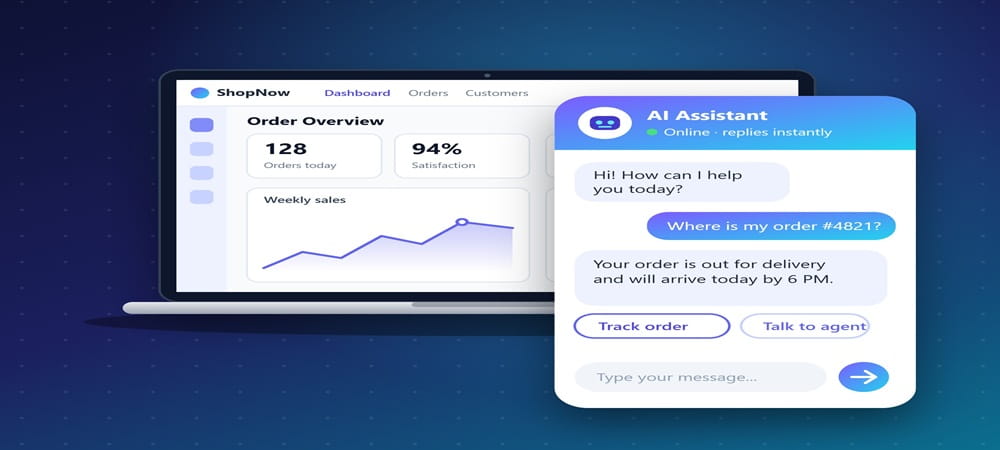
How AI Chatbots Improve Web App Experiences
How AI Chatbots Improve Web App Experiences
Customer expectations are changing rapidly, and businesses must find better ways to deliver quick, personalized, and reliable support. AI chatbots in web applications are becoming an important part of this transformation by helping businesses communicate with customers, answer questions instantly, and help around the clock. Unlike traditional customer support systems that depend entirely on human agents, AI-powered chatbots can handle multiple conversations simultaneously, understand user queries, and guide visitors toward the information or services they need. As businesses increasingly focus on digital experiences, integrating AI chatbots into web applications is becoming a practical way to improve customer satisfaction and build stronger relationships.
What Are AI Chatbots in Web Applications?
AI chatbots are software applications designed to communicate with users through text or voice conversations. They use technologies such as Artificial Intelligence (AI), Natural Language Processing (NLP), and Machine Learning (ML) to understand questions, interpret user intent, and generate relevant responses.
When integrated into a web application, chatbots act as virtual assistants that help visitors navigate different features, find information, resolve common issues, and complete specific tasks.
For example, an e-commerce web application can use an AI chatbot to help customers track orders, understand product details, check return policies, and receive personalized recommendations. Similarly, a business service platform can use chatbots to answer service-related questions, collect customer inquiries, and schedule consultations.
Modern AI chatbots go beyond predefined responses. They can understand conversational language, use available business information, and provide more relevant answers based on the context of a conversation.
Why Customer Experience Matters in Modern Web Applications
A well-designed web application should provide more information or complete transactions. It should make every interaction simple, convenient, and valuable for users.
Customers expect websites and web applications to be easy to navigate, responsive, and capable of providing immediate assistance. When users cannot find answers to their questions or experience delays in getting support, they may leave the platform and look for alternatives.
This is where AI-powered customer support can make a difference.
Businesses can integrate intelligent chatbots into their web applications to reduce communication gaps, simplify customer interactions, and make digital services more accessible.
A better customer experience can help businesses:
- Improve customer satisfaction and engagement.
- Reduce response times for common inquiries.
- Provide consistent support across different user interactions.
- Make website navigation easier.
- Build customer trust and long-term relationships.
- Support customers outside regular business hours.
By making assistance available throughout the customer journey, businesses can create a smoother and more convenient digital experience.
7 Ways AI Chatbots Are Improving Customer Experience in Web Applications
1. Providing Instant Customer Support
One of the biggest advantages of integrating AI chatbots into web applications is the ability to provide immediate customer assistance.
Traditional support systems often require customers to submit tickets, send emails, or wait for an available representative. These delays can create frustration, especially when users need quick answers.
AI chatbots can respond to frequently asked questions within seconds. Whether someone wants to understand a service, check account information, or resolve a basic issue, the chatbot can provide relevant assistance without requiring users to wait in a support queue.
For example, a SaaS company can integrate a chatbot into its web application to help users understand subscription plans, reset passwords, and troubleshoot common problems.
This allows customers to find answers quickly while helping businesses manage incoming support requests more efficiently.
2. Delivering Personalized User Experiences
Customers appreciate digital experiences that understand their requirements rather than providing the same information to everyone.
AI chatbots can use conversation context and, where permitted, relevant customer information to provide more personalized interactions.
For instance, an online shopping platform can recommend products based on a customer’s preferences, previous interactions, or current product searches. A service-based business can use chatbot conversations to understand customer requirements before suggesting suitable services.
Personalized chatbot interactions can help users discover relevant information more easily and reduce the effort required to find what they need.
However, businesses should ensure that personalization follows appropriate data privacy practices and gives customers control over their information.
3. Offering 24/7 Customer Assistance
Customer inquiries do not always arrive during business hours. A visitor may need information late at night, during weekends, or while working from a different time zone.
AI chatbots help businesses overcome this limitation by making basic customer assistance available 24/7.
Unlike human support teams, chatbots do not need scheduled working hours. They can respond to common questions, share important information, and guide visitors whenever they access the web application.
This is particularly valuable for businesses serving international customers.
For example, a software development company can use an AI chatbot to collect project requirements, answer questions about services, and capture consultation requests even when its support team is unavailable.
Although complex issues may still require human assistance, round-the-clock chatbot availability makes customer support more accessible.
4. Simplifying Website Navigation and User Onboarding
Not every visitor knows how to use a new web application. Complicated menus, unfamiliar features, and lengthy instructions can make the experience confusing.
AI chatbots can simplify navigation by guiding users through different sections of an application.
For example, a newly registered user on a project management platform might ask:
- How do I create my first project?
- Where can I invite team members?
- How do I manage project permissions?
- Where can I find my account settings?
Instead of searching through multiple pages or documentation, users can receive step-by-step guidance through a chatbot.
This is especially useful for SaaS platforms, enterprise applications, customer portals, and other web-based business solutions.
An interactive onboarding experience can help users understand application features faster and become comfortable using the platform.
5. Reducing Customer Support Workload
Customer support teams often spend a considerable amount of time answering repetitive questions. These may include account-related inquiries, pricing information, order updates, password assistance, and basic troubleshooting.
AI chatbots can automate many of these routine interactions.
By handling frequently asked questions and simple support requests, chatbots allow human agents to focus on more complicated customer issues that require personal attention and decision-making.
For example, an online service platform can use a chatbot to collect basic information about a technical issue before transferring the conversation to a support representative.
This creates a more organized support process and helps businesses manage customer inquiries more effectively.
The goal is not to eliminate human support but to create a better balance between automated assistance and human expertise.
6. Improving Lead Generation and Customer Engagement
AI chatbots can also contribute to business growth by turning website visitors into potential customers.
Many visitors explore business websites without submitting contact forms or directly contacting the sales team. Sometimes, they simply need additional information before making a decision.
An AI chatbot can engage these visitors by asking relevant questions, understanding their requirements, and guiding them toward suitable services.
For example, a web application development company can use a chatbot to ask visitors about:
- The type of application they want to develop.
- Their preferred features and functionalities.
- Their business requirements.
- Their expected project timeline.
- Their preferred method of communication.
Based on the responses, the chatbot can collect relevant lead information and direct qualified inquiries to the sales team.
This makes the customer journey more interactive while helping businesses identify potential opportunities.
7. Supporting Multiple Languages and Global Customers
Businesses serving international markets need to communicate with customers from different linguistic backgrounds.
Language barriers can make it difficult for users to understand services, navigate applications, and receive support.
AI-powered chatbots with multilingual capabilities can help address this challenge by understanding and responding in supported languages.
For example, an international e-commerce platform can provide chatbot assistance to customers who prefer communicating in different languages.
This makes digital services more accessible and helps businesses create a more inclusive customer experience.
However, multilingual performance depends on the chatbot model, language support, and quality of its training and configuration.
Real-World Applications of AI Chatbots Across Industries
AI chatbots are not limited to customer support. Businesses across different industries are integrating them into web applications to simplify communication and improve digital services.
| Industry | How AI chatbots help |
| E-commerce | Product recommendations, order tracking, and return assistance. |
| Healthcare | Appointment scheduling, general information, and patient navigation. |
| Banking and Finance | Basic account inquiries, transaction guidance, and service information. |
| Education | Course information, student support, and admission inquiries. |
| Manufacturing | Product information, technical documentation, and service requests. |
| Travel and Hospitality | Booking assistance, travel information, and reservation inquiries. |
| SaaS Businesses | User onboarding, troubleshooting, and subscription assistance. |
These applications demonstrate how AI chatbots can support different customer journeys while making web-based services more convenient.
AI Chatbots vs. Traditional Chatbots: What’s the Difference?
Not all chatbots offer the same capabilities. Traditional chatbots generally depend on predefined rules and decision trees, while AI-powered chatbots can interpret natural language and respond based on conversational context.
Understanding the difference helps businesses choose the right solution for their requirements.
| Feature | Traditional Chatbots | AI-Powered Chatbots |
| Response system | Predefined rules | AI-generated or AI-selected responses |
| Query understanding | Keyword-based | Natural language understanding |
| Personalization | Limited | Context-based personalization |
| Handling complex queries | Limited | Better conversational flexibility |
| Learning capabilities | Requires manual updates | Can improve through suitable model updates and feedback |
| User interaction | Script-based | More conversational |
Traditional chatbots can still be useful for simple tasks, such as answering fixed questions or directing users to specific pages.
However, businesses that require more flexible communication, contextual understanding, and personalized assistance may benefit from AI-powered solutions.
Key Considerations Before Integrating AI Chatbots into a Web Application
Although AI chatbots offer several advantages, successful implementation requires proper planning. Simply adding a chatbot to a website does not guarantee a better customer experience.
Businesses should consider the following factors before integrating one.
1. Define clear objectives: Identify whether the chatbot will handle customer support, lead generation, onboarding, product recommendations, or multiple functions.
2. Choose the right AI technology: Select suitable AI models and NLP capabilities based on the complexity of user interactions.
3. Integrate with existing systems: Connect the chatbot with relevant CRM platforms, databases, knowledge bases, or customer support systems where required.
4. Prioritize data security: Protect customer information through appropriate access controls, secure integrations, and privacy practices.
5. Provide human support options: Ensure users can connect with a human representative when the chatbot cannot resolve their concerns.
6. Monitor chatbot performance: Regularly evaluate response accuracy, resolution rates, customer satisfaction, and unanswered queries.
7. Keep information updated: Maintain accurate knowledge sources so that chatbots provide relevant and reliable information.
A carefully planned implementation helps businesses create a chatbot experience that supports users without making digital interactions unnecessarily complicated.
The Future of AI Chatbots in Web Application Development
AI chatbots are moving beyond basic question-and-answer interactions. With advancements in generative AI, conversational AI, and AI agents, businesses are exploring more intelligent ways to automate digital experiences.
Future web applications are likely to feature chatbots that can understand complex requests, interact with connected business systems, and perform specific tasks with appropriate permissions.
For example, instead of simply explaining how to schedule an appointment, an AI assistant may be able to check available slots and help complete the booking process.
Similarly, enterprise web applications may use AI assistants to retrieve business information, summarize reports, and support employees with routine workflows.
The growing integration of AI into web application development will create new opportunities for businesses to improve customer engagement, streamline operations, and deliver more responsive digital services.
However, the success of these solutions will depend on responsible AI implementation, reliable information, data protection, and a well-designed user experience.
Conclusion
AI chatbots are changing how businesses interact with customers through web applications. From providing instant support and personalized recommendations to simplifying onboarding and improving lead generation, they offer practical ways to make digital experiences more efficient and user-friendly.
As customer expectations continue to evolve, businesses that invest in intelligent and well-integrated web solutions can create more convenient ways for users to access information and services.
At Sapizon Technologies, we understand the importance of building modern digital solutions that align with changing business needs. Through custom web application development and emerging technology integration, we help businesses explore smarter ways to improve operations and customer experiences.
Ready to make your web application smarter with AI? Connect with Sapizon Technologies to explore the right solution for your business.