
How XR is Revolutionizing Training in Wind Turbine Industry
How XR is Revolutionizing Training in Wind Turbine Industry
The wind energy industry is expanding rapidly, and manufacturers are under pressure to build larger, more efficient turbines while maintaining high standards of quality and safety. As production volumes increase, companies are ams, and quality inspectors quickly and effectively. This is where XR training for wind turbine manufacturing is creating a major shift in the way industrial workforce training is delivered.
Traditional training methods often rely on classroom sessions, printed manuals, videos, and supervised on-the-job learning. While these methods still have value, they can be time-consuming, inconsistent, and difficult to scale across multiple manufacturing plants. Extended Reality (XR), which includes Virtual Reality (VR), Augmented Reality (AR), and Mixed Reality (MR), offers a more immersive and interactive approach that allows employees to learn by doing it in a safe digital environment.
In this blog, we will explore how XR is transforming training in wind turbine manufacturing, the key benefits it brings, and why forward-thinking renewable energy companies are investing in immersive workforce development solutions.
Understanding XR in Wind Turbine Manufacturing
Extended Reality is an umbrella term that combines three technologies:
- Virtual Reality (VR): Creates a fully immersive digital environment where trainees can practice tasks using VR headsets.
- Augmented Reality (AR): Overlays digital instructions, 3D models, and guidance on the real-world environment.
- Mixed Reality (MR): Blends physical and digital objects, allowing users to interact with virtual components as if they were real.
In a wind turbine manufacturing plant, XR can be used to simulate blade assembly, nacelle integration, gearbox installation, electrical wiring, torque procedures, quality inspections, and maintenance operations. Trainees can repeat these tasks multiple times without risking damage to expensive equipment or compromising worker safety.
Why Traditional Training Is No Longer Enough
Wind turbine manufacturing involves complex processes and strict safety requirements. New employees often need weeks or even months of hands-on training before they become fully productive. Some of the common challenges include:
High training costs
Manufacturers must allocate machines, tools, materials, and experienced trainers for every training session. This increases operational costs and can reduce production efficiency.
Safety risks
Working with heavy components, elevated platforms, and electrical systems can expose trainees to significant hazards.
Inconsistent knowledge transfer
Different trainers may teach procedures differently, leading to variations in assembly quality and operational performance.
Limited access to equipment
Critical production equipment cannot always be taken offline for training purposes, which restricts hands-on learning opportunities.
XR addresses these challenges by providing a standardized, repeatable, and scalable training environment.
How XR Improves Assembly Training
One of the most impactful applications of XR is in wind turbine assembly training.
Blade assembly
Wind turbine blades are large, expensive, and require precise handling. Using VR simulations, trainees can learn blade positioning, fastening sequences, bonding procedures, and inspection steps before working on actual components.
Nacelle integration
The nacelle contains the gearbox, generator, brake system, and control electronics. XR allows workers to explore the internal layout in 3D, understand component relationships, and practice installation procedures in a virtual environment.
Torque and fastening procedures
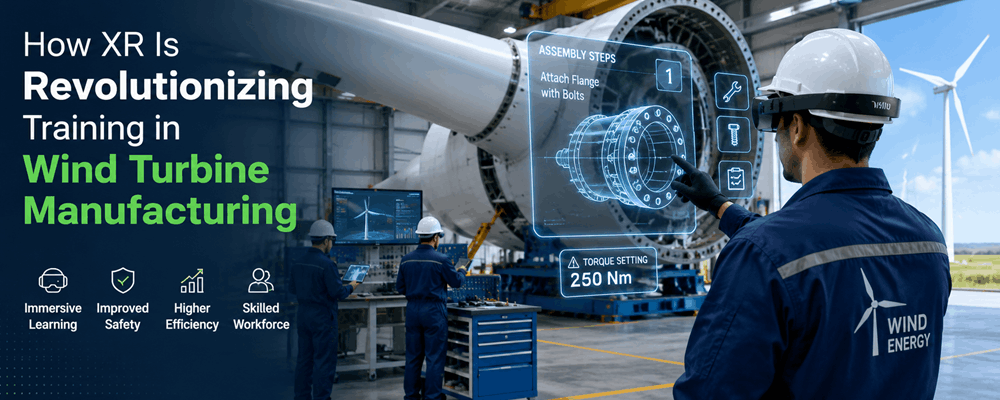
Improper torque application can lead to equipment failures and costly rework. AR-based digital work instructions can guide technicians step by step, showing the correct torque values, tightening sequence, and tool usage in real time.
By practicing these procedures virtually, employees gain confidence and muscle memory before entering the production line.
Faster Onboarding for New Employees
Hiring and retaining skilled workers is a major challenge in the renewable energy manufacturing sector. XR helps reduce the learning curve for new employees by providing interactive training modules that are easier to understand than traditional manuals.
A new technician can:
- Explore a virtual wind turbine assembly line
- Identify components and tools
- Practice safety procedures
- Complete guided assembly tasks
- Receive instant feedback on errors
Because the training is self-paced and repeatable, employees can learn more efficiently and retain information for a longer period. Many manufacturers report shorter onboarding times and faster productivity ramp-up after implementing immersive training programs.
Enhancing Safety Training in Windmill Manufacturing
Safety is a top priority in wind turbine manufacturing. Workers often operate at heights, handle heavy equipment, and work near high-voltage electrical systems.
XR enables realistic safety simulations that would be difficult or dangerous to conduct in the real world.
Working at heights
Trainees can practice climbing procedures, fall protection checks, and emergency evacuation protocols in a virtual environment.
Electrical safety
VR scenarios can simulate lockout/tagout procedures, arc flash hazards, and fault conditions without exposing workers to actual electrical risks.
Emergency response
Teams can rehearse fire response, equipment failure, and evacuation procedures repeatedly until they become second in nature.
These immersive experiences improve hazard awareness and help employees respond more effectively during real emergencies.
AR-Based Digital Work Instructions
Printed manuals are often difficult to follow, especially when workers need to reference diagrams while performing assembly tasks. AR-based digital work instructions solve this problem by displaying information directly in the technician’s field of view.
For example, an AR headset can show:
- 3D assembly animations
- Correct part orientation
- Torque specifications
- Wiring routes
- Inspection checkpoints
- Quality alerts
This hands-free guidance reduces errors, improves efficiency, and ensures that procedures are followed consistently across shifts and locations.
Remote Expert Assistance with XR
Wind turbine manufacturing plants may not always have specialized experts available on-site. XR enables remote collaboration, allowing experienced engineers to assist technicians from anywhere in the world.
A technician wearing an AR headset can share a live view of the equipment with a remote expert, who can:
- Annotate the worker’s view
- Highlight components
- Provide troubleshooting guidance
- Verify assembly steps
- Support quality inspections
This capability is especially valuable for complex assembly operations and for training teams in multiple manufacturing facilities.
Improving Quality Control Through Immersive Training
Quality control is critical in wind turbine manufacturing because even small defects can affect turbine performance and reliability.
XR-based inspection training allows quality inspectors to practice identifying:
- Surface defects
- Bonding issues
- Alignment problems
- Wiring errors
- Fastener inconsistencies
Interactive 3D models can demonstrate both correct and incorrect assembly conditions, helping inspectors develop a sharper understanding of quality standards.
By standardizing inspection training, manufacturers can reduce variability and improve overall product quality.
The Role of Digital Twins in XR Training
Many advanced manufacturers are combining XR with digital twin technology. A digital twin is a virtual representation of a physical wind turbine or manufacturing process.
When integrated with XR, digital twins allow trainees to interact with real operational data, including:
- Component temperatures
- Vibration levels
- Performance metrics
- Maintenance history
- Fault conditions
This creates a highly realistic training environment where workers can learn how equipment behaves under different operating conditions.
For example, maintenance technicians can practice diagnosing gearbox vibration issues or generator overheating scenarios using data-driven simulations that mirror real-world conditions.
Measurable Benefits of XR Training
Companies adopting XR for wind turbine manufacturing training are seeing measurable improvements in several areas.
Reduced training time
Immersive learning helps employees understand procedures faster, reducing the time required to become job ready.
Lower training costs
Virtual simulations reduce the need for physical training equipment, consumable materials, and production downtime.
Improved safety performance
Workers gain experience handling hazardous situations in a risk-free environment.
Higher assembly accuracy
Digital guidance and standardized procedures help reduce human error and rework.
Better knowledge retention
Interactive learning experiences are generally more memorable than passive classroom instruction.
These benefits contribute directly to improved productivity and operational efficiency.
Real-World Applications in the Renewable Energy Industry
Leading wind energy manufacturers are already using XR for:
- Blade manufacturing training
- Nacelle assembly simulation
- Electrical wiring instruction
- Maintenance procedure rehearsal
- Crane operation familiarization
- Safety certification programs
- Remote troubleshooting support
As hardware becomes more affordable and software platforms become easier to deploy, XR adoption is expected to accelerate across the renewable energy manufacturing sector.
Overcoming Implementation Challenges
While XR offers significant advantages, successful implementation requires careful planning.
Start with high-impact use cases
Focus on tasks that are expensive, hazardous, or difficult to train using traditional methods.
Involve experienced technicians
Subject to matter experts should help design training scenarios to ensure accuracy and relevance.
Integrate with existing systems
XR training should connect with learning management systems, quality processes, and maintenance documentation.
Measure performance
Track metrics such as training completion time, error rates, safety incidents, and productivity improvements to evaluate ROI.
By taking a phased approach, manufacturers can achieve quick wins and build internal support for broader XR adoption.
The Future of XR in Wind Turbine Manufacturing
The future of industrial training is becoming increasingly immersive and intelligent. Emerging trends include:
- AI-powered virtual instructors
- Voice-controlled AR guidance
- Real-time performance analytics
- Haptic feedback for realistic tool interaction
- Cloud-based multi-user training environments
- Predictive maintenance simulations
As wind turbines become larger and more technologically advanced, the demand for highly skilled technicians will continue to grow. XR provides a scalable way to develop these skills while maintaining safety, quality, and operational efficiency.
Conclusion
Wind turbine manufacturing is entering a new era of digital transformation, and workforce training is at the center of this change. XR is no longer an experimental technology – it is becoming a practical tool for reducing training time, improving safety, enhancing assembly accuracy, and accelerating employee onboarding.
By combining VR simulations, AR-based digital work instructions, and MR collaboration tools, manufacturers can create immersive training experiences that prepare workers for real-world tasks more effectively than traditional methods alone.
For renewable energy companies looking to build a future-ready workforce, investing in XR-based training is not just about adopting new technology. It is about creating a safer, more efficient, and more skilled manufacturing environment that can support the growing global demand for wind energy.
As the industry continues to evolve, the manufacturers that embrace immersive workforce training today will be better positioned to improve productivity, maintain quality standards, and lead to the next generation of wind turbine innovation.