
What a Custom Mobile App Development Helps Businesses to Scale
What a Custom Mobile App Development Helps Businesses to Scale
In a digital-first market, businesses are constantly looking for better ways to reach customers, improve operations, and stay ahead of competitors. Mobile apps have become an important part of this transformation. However, simply having a mobile application is not enough. Businesses need solutions that are designed around their specific goals, customers, and workflows. This is where custom mobile app development becomes valuable.
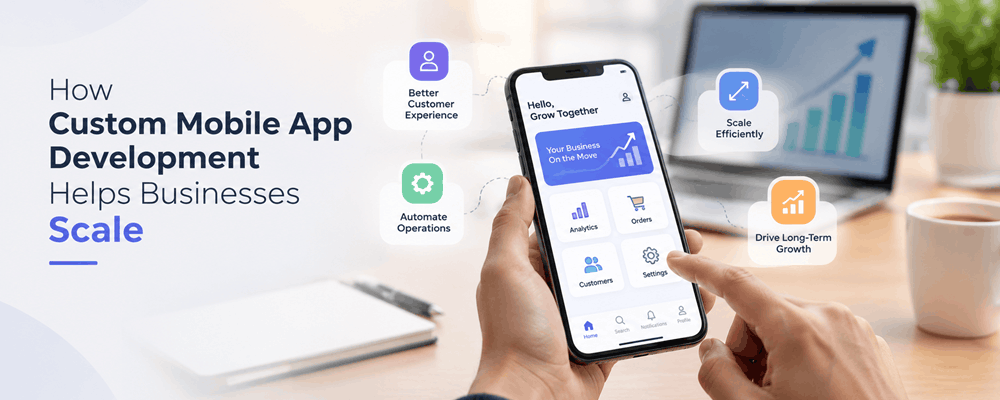
Unlike generic applications that offer limited flexibility, a custom mobile app is built around the unique requirements of a business. From improving customer engagement to automating internal processes, a well-designed app can become a long-term growth engine. For startups, growing companies, and established enterprises, custom mobile application development can provide the flexibility needed to scale without constantly replacing or rebuilding technology.
What Is Custom Mobile App Development?
Custom mobile app development is the process of designing and developing an application specifically for a particular business, audience, or use case.
Instead of adapting business processes to fit an existing application, custom development allows businesses to build features around their actual requirements. This can include customer-facing apps, employee applications, e-commerce platforms, field-service applications, enterprise mobility solutions, and industry-specific software.
A custom application can also integrate with existing business systems such as CRM platforms, payment gateways, cloud services, ERP systems, analytics tools, and third-party APIs.
This flexibility makes custom apps more than just another digital channel. They can become an important part of a company’s overall technology ecosystem.
Why Businesses Are Investing in Custom Mobile Apps
Customer expectations have changed significantly. People expect businesses to provide fast, convenient, and personalized digital experiences. At the same time, companies need technology that can support growing operations without creating unnecessary complexity.
A custom mobile application can address both sides of this challenge.
Businesses can create experiences specifically designed for their target audience while building the technical foundation required for future growth. Instead of relying on a one-size-fits-all solution, companies can decide which features matter most and expand them as their requirements evolve.
Here are some of the major ways custom mobile app development can support business growth.
1. Creates a Better Customer Experience
Customer experience can directly influence how people interact with a brand. A complicated website, slow process, or disconnected customer journey can encourage users to look elsewhere.
A custom mobile app gives businesses greater control over customer experience.
Companies can create simple navigation, personalized dashboards, faster checkout processes, push notifications, loyalty programs, in-app support, and other features based on their audience’s needs.
For example, an e-commerce business can build an app that remembers customer preferences, recommends relevant products, provides real-time order updates, and simplifies repeat purchases.
When customers can complete tasks quickly and conveniently, businesses have more opportunities to build long-term relationships.
2. Supports Business Process Automation
Scaling a business often means managing more customers, employees, orders, and data. If these processes are handled manually, operational workloads can increase quickly.
Custom mobile applications can automate repetitive tasks and reduce unnecessary manual work.
For example, a field-service company could develop an employee app where technicians receive assignments, update job status, upload images, collect customer signatures, and submit reports directly from their mobile devices.
Instead of managing information across spreadsheets, phone calls, and emails, businesses can centralize important workflows within one platform.
This can improve productivity while allowing employees to spend more time on higher-value activities.
3. Provides Scalability as the Business Grows
One of the biggest advantages of custom mobile app development is scalability.
A business may start with a few essential features and gradually introduce new functionality as its customer base grows. A custom solution can be planned with this future expansion in mind.
For example, a startup might initially launch an app with user registration, product browsing, and payments. As the company grows, it could introduce subscriptions, loyalty programs, advanced analytics, AI-powered recommendations, multilingual support, or integration with additional services.
This approach allows the application to evolve alongside the business rather than forcing the company to change platforms every time its requirements change.
4. Enables Integration with Existing Systems
Businesses rarely operate using a single software system. They may already use CRM, ERP, accounting, inventory, marketing, customer support, and analytics platforms.
A custom mobile app can be developed to communicate with these existing systems through APIs and other integrations.
For example, when a customer places an order through a mobile app, the information can relate to inventory and order management systems. Employees can then access updated information without manually entering the same data into multiple platforms.
This connected approach can reduce data silos and create a smoother flow of information across the organization.
5. Helps Businesses Make Data-Driven Decisions
Every interaction within a mobile application can provide useful business insights when data is collected and analyzed responsibly.
Businesses can understand how users interact with features, where customers drop off, which products receive the most attention, and which services generate repeat engagement.
These insights can support better decisions around product development, marketing, customer service, and business operations.
For example, an online retailer can analyze browsing and purchasing patterns to improve product recommendations and promotional campaigns.
Custom analytics dashboards can also give management teams a clearer view of important business metrics.
6. Strengthens Brand Identity
A mobile application is another opportunity for businesses to create a consistent brand experience.
With a custom app, companies have greater control over the interface, visual identity, functionality, communication, and overall user journey.
From the app icon and onboarding experience to notifications and in-app interactions, every touchpoint can reflect the company’s brand.
This can help businesses create a more recognizable digital presence and maintain consistency across different customer channels.
7. Improves Customer Engagement and Retention
Getting a new customer is only one part of business growth. Keeping existing customers engaged can be equally important.
Mobile apps provide businesses with a direct communication channel. Features such as personalized notifications, loyalty rewards, reminders, exclusive offers, and in-app messaging can encourage customers to return.
However, engagement should be relevant rather than excessive. Businesses that use customer data responsibly and provide genuinely useful communication are better positioned to create positive experiences.
A thoughtfully designed mobile application can therefore become a continuous connection between a business and its customers.
8. Provides a Competitive Advantage
In competitive industries, digital convenience can influence purchasing decisions.
Businesses that provide a smoother mobile experience may be able to differentiate themselves from competitors that rely entirely on traditional channels.
Custom development also allows companies to experiment with new features and technologies. Depending on the business use case, applications can incorporate technologies such as artificial intelligence, cloud computing, Internet of Things connectivity, augmented reality, or real-time analytics.
This creates opportunities for businesses to develop services that are difficult to replicate using generic software.
9. Supports Long-Term Cost Efficiency
Custom development requires an initial investment, but the long-term value should be considered alongside the upfront cost.
A business using multiple disconnected tools may pay for several subscriptions while also spending time moving information between systems. A custom application can bring important workflows together in a single environment.
It can also reduce dependency on unnecessary features that come with generic platforms.
When properly planned, a scalable mobile application can become a long-term technology asset rather than simply another software expense.
What Makes a Custom Mobile App Successful?
Developing an app does not automatically guarantee business growth. The application needs to solve a genuine problem and provide measurable value.
Before development begins, businesses should clearly define their target audience, business objectives, essential features, integrations, security requirements, and future scalability needs.
User experience should also be a priority. An application with impressive technology but confusing navigation can struggle to gain adoption.
Performance, security, regular updates, analytics, and ongoing maintenance are equally important. Mobile app development should therefore be treated as an ongoing process rather than a one-time project.
Choosing the Right Mobile App Development Partner
The right development partner can influence the success of a mobile application from planning through deployment and beyond.
Businesses should look for a development team that understands their industry, can translate business requirements into technical solutions, follow a structured development process, and provide support after launch.
The technology stack should also be selected according to the application requirements rather than simply following trends. Depending on the project, businesses may choose native development or cross-platform technologies to achieve the desired balance between performance, development speed, scalability, and maintenance.
A strong development partner should also consider security, API integrations, cloud infrastructure, testing, analytics, and future upgrades from the beginning.
Final Thoughts
Business growth increasingly depends on how effectively companies use technology to serve customers and improve operations. Custom mobile app development gives businesses the flexibility to create digital solutions around their specific requirements instead of adapting their processes to generic software.
From improving customer experiences and automating workflows to supporting scalability, data-driven decisions, and stronger engagement, a well-planned mobile application can contribute to multiple areas of business growth.
At Sapizon Technologies, we help businesses build custom digital solutions designed around their unique goals and operational requirements. Our mobile app development services focus on creating scalable, user-friendly, and business-oriented applications that can evolve as organizations grow.
Whether you are planning a new mobile product or looking to modernize an existing application, a carefully designed mobile strategy can provide the foundation for sustainable digital growth.