
How XR is Transforming Heavy Machinery Manufacturing
How XR is Transforming Heavy Machinery Manufacturing
Manufacturing large and complex machinery is not a simple process. From designing massive industrial equipment and assembling thousands of components to training technicians and maintaining strict quality standards, heavy machinery manufacturers deal with challenges that require precision at every stage. This is where XR in manufacturing is becoming an increasingly valuable technology.
Extended Reality, or XR, brings together Virtual Reality (VR), Augmented Reality (AR), and Mixed Reality (MR) to create immersive digital experiences. For heavy machinery manufacturers, XR can help employees visualize complex systems, practice difficult tasks in a safe environment, access digital instructions while working, and collaborate with experts from different locations.
As machinery becomes more advanced and manufacturing operations become increasingly digital, traditional training manuals, 2D drawings, and classroom-based learning may not always be enough. XR provides a more interactive way to connect people with machines, processes, and information.
In this blog, we’ll explore how XR is transforming the heavy machinery manufacturing industry, its key benefits, practical use cases, challenges, and how manufacturers can start implementing immersive technologies.
Table of Contents
- What Is XR in Manufacturing?
- Why Heavy Machinery Manufacturers Need XR
- Key Benefits of XR in Heavy Machinery Manufacturing
- How XR Is Used Across the Manufacturing Process
- XR for Employee Training and Skill Development
- XR for Assembly and Maintenance
- XR for Design and Product Visualization
- Remote Collaboration With XR
- Improving Quality and Reducing Errors
- Challenges of Implementing XR
- How Heavy Machinery Manufacturers Can Get Started
- The Future of XR in Manufacturing
- Frequently Asked Questions
- Conclusion
What Is XR in Manufacturing?
XR, or Extended Reality, is an umbrella term used to describe immersive technologies such as Virtual Reality, Augmented Reality, and Mixed Reality.
Each technology can support manufacturing in different ways.
Virtual Reality
Virtual Reality creates a fully digital environment that users can experience through a VR headset. In heavy machinery manufacturing, VR can be used to simulate factory environments, machinery operations, assembly processes, and safety scenarios.
For example, a new technician can practice assembling a complex hydraulic system in a virtual environment before working on the actual equipment.
Augmented Reality
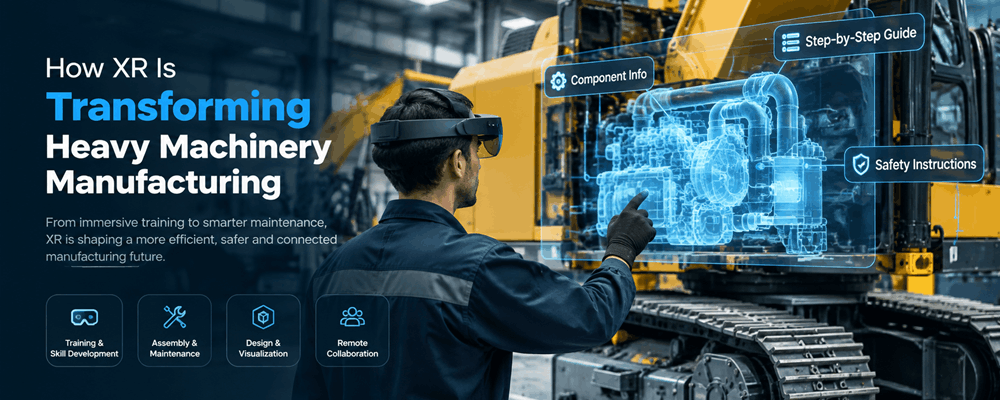
Augmented Reality adds digital information to the real-world environment. Using AR glasses, tablets, or other devices, technicians can view instructions, component information, measurements, or step-by-step guidance while working on a machine.
Instead of repeatedly checking a paper manual, workers can access relevant information directly while performing the task.
Mixed Reality
Mixed Reality combines physical and digital environments more interactively. Digital models can be placed and viewed within real spaces, allowing users to interact with virtual objects while remaining aware of their physical surroundings.
For heavy machinery manufacturers, this can be particularly useful for visualization, inspection, training, and collaboration.
Together, these technologies can create a more connected and immersive manufacturing environment.
Why Heavy Machinery Manufacturers Need XR
Heavy machinery manufacturing comes with challenges that are different from those faced in simpler production environments.
A single machine may include thousands of components, complex mechanical systems, electrical connections, hydraulic systems, sensors, and advanced software. Employees may require months of training before they become fully comfortable working with specific equipment.
Manufacturers also face challenges such as:
- Complex assembly processes
- High training costs
- Limited availability of experienced technicians
- Safety risks during training
- Human errors during assembly
- Difficulty visualizing large equipment designs
- Expensive machine downtime
- Challenges in remote troubleshooting
- Knowledge loss when experienced employees retire
Traditional methods still have an important role, but they may not always provide the level of interaction needed for complex machinery.
XR can help bridge the gap between digital information and real-world manufacturing activities.
Key Benefits of XR in Heavy Machinery Manufacturing
1. Improved Employee Training
Training employees to operate, assemble, or maintain large machinery can be expensive and time-consuming.
With XR, employees can learn by doing in a simulated or guided environment. They can repeat procedures multiple times without requiring access to an actual machine.
This is especially useful when training involves expensive equipment, complex procedures, or potentially hazardous situations.
A technician can, for example, practice identifying a fault, removing a component, and completing the repair process before performing the task in the real world.
2. Reduced Training Risks
Heavy machinery environments often involve significant safety considerations. Employees may work around moving equipment, electrical systems, high-pressure components, or heavy parts.
XR allows companies to simulate certain situations without exposing trainees to the same level of physical risk.
Workers can experience safety scenarios, learn how to respond to emergencies, and understand proper procedures in a controlled environment.
This can help employees build confidence before working on the factory floor.
3. Better Knowledge Retention
Reading a manual and performing a task are two very different experiences.
Immersive learning can make training more interactive by allowing employees to see processes and actively participate in them. Instead of simply reading about how a machine works, they can explore its components and understand how different systems interact.
This is particularly valuable when employees need to understand complex machinery with multiple interconnected systems.
4. Fewer Assembly Errors
Assembly errors can lead to delays, rework, additional costs, and quality issues.
XR can provide workers with visual instructions during the assembly process. Digital guidance can help employees identify the correct component, understand its placement, and follow the required sequence.
For complex machinery, even small mistakes can create larger problems later in the production process. Providing information at the point of work can help reduce dependence on memory alone.
5. Reduced Machine Downtime
When a machine experiences a problem, identifying and resolving the issue quickly is important.
XR can support maintenance teams by providing visual guidance, equipment information, and remote expert assistance.
A technician working at a customer site or manufacturing facility may be able to connect with an experienced engineer who can view the situation and provide guidance remotely.
This can reduce delays associated with waiting for an expert to travel to the location.
How XR Is Used Across the Heavy Machinery Manufacturing Process
XR is not limited to one department. It can support different stages of the machinery lifecycle.
Design and Engineering
Before a physical prototype is built, engineers can use immersive technologies to visualize equipment at scale.
Large machinery can be difficult to evaluate using only 2D drawings or computer screens. XR can allow teams to experience a digital model in a more realistic way.
Engineers may be able to:
- Visualize machinery at full scale
- Examine component placement
- Identify potential design issues
- Review accessibility for maintenance
- Collaborate with other teams
- Demonstrate concepts to stakeholders
This can improve communication between engineering, production, service, and management teams.
Assembly
Assembly teams can use XR-based instructions to support complex processes.
Imagine an employee working on a large industrial machine with hundreds of components. Instead of searching through a lengthy manual, the employee can receive step-by-step guidance related to the specific task.
The system may show:
- Which component to install
- Where it should be placed
- The correct assembly sequence
- Safety instructions
- Inspection points
This can be especially useful for new employees or when manufacturing different machine configurations.
Quality Inspection
Quality teams need to ensure that machinery is assembled according to required specifications.
XR can help inspectors compare physical equipment with digital models or access relevant inspection information during the process.
Visual guidance may make it easier to identify missing components, incorrect placements, or deviations from the required design.
While XR does not replace a complete quality management system, it can provide an additional digital layer to support inspection activities.
XR for Employee Training and Skill Development
One of the strongest applications of XR in manufacturing is employee training.
Heavy machinery manufacturers often need to train employees on:
- Machine assembly
- Equipment operation
- Maintenance procedures
- Safety protocols
- Troubleshooting
- Quality inspection
- Emergency response
Traditional training may involve classroom sessions, manuals, videos, and supervised practical experience.
XR can complement these methods by creating more hands-on learning experiences.
For example, a new employee can enter a virtual manufacturing environment and practice a specific procedure step by step. If the employee makes a mistake, the simulation can allow them to repeat the task.
This creates an opportunity to learn through practice without necessarily interrupting production or using expensive equipment for basic training.
Experienced employees can also benefit when learning new procedures, new machinery models, or updated manufacturing processes.
XR for Complex Assembly and Maintenance
Heavy machinery often requires precise assembly and maintenance procedures.
Consider a technician working on a large mining machine, construction equipment, industrial system, or specialized manufacturing machine. The process may involve numerous steps and require knowledge of mechanical, hydraulic, and electrical systems.
XR can make technical information more accessible at the moment it is needed.
For example, an AR solution could guide a technician through a maintenance procedure by displaying relevant information as they work.
The experience could include:
- Identification of the correct machine component
- Step-by-step instructions
- Safety reminders
- Required tools
- Visual assembly or disassembly guidance
- Inspection checkpoints
This approach can help standardize processes across different employees and locations.
XR for Design and Product Visualization
Building physical prototypes of large machinery can require significant time and investment.
XR allows manufacturers to explore digital designs before every decision requires a physical model.
Engineers, managers, customers, and other stakeholders can potentially experience a machine design in an immersive environment.
This can make discussions more productive.
Instead of saying, “The component may be difficult to access,” a team can virtually examine the machine and assess the accessibility.
XR can also support customer demonstrations.
A company manufacturing large industrial equipment may not be able to transport every machine to a potential customer’s location. An immersive experience can provide a different way to demonstrate the equipment, its features, and how it operates.
Remote Collaboration With XR
Heavy machinery manufacturing often involves experts working across different plants, offices, or geographic locations.
When a technical issue occurs, getting the right expert to the right location can take time.
XR-based remote collaboration can help connect on-site employees with remote specialists.
A field technician may share what they are seeing with an expert, who can provide instructions and guidance.
This can be useful for:
- Troubleshooting technical problems
- Supporting maintenance teams
- Assisting field service engineers
- Conducting remote inspections
- Training employees
- Solving unexpected production issues
Remote collaboration does not eliminate the need for physical expertise, but it can make expert knowledge more accessible when travel is not immediately practical.
Improving Quality and Reducing Human Errors
Human error is a reality in every manufacturing environment, especially when employees perform complex and repetitive tasks.
In heavy machinery manufacturing, mistakes can be costly.
XR can provide contextual information during the work process, helping employees access the right information at the right time.
Instead of relying entirely on memory or switching between the machine and a manual, workers may receive guidance within their working environment.
Potential applications include:
- Assembly verification
- Component identification
- Inspection guidance
- Process standardization
- Training for new procedures
- Digital work instructions
The goal is not to replace skilled workers. Instead, XR can support them by making complex information easier to access and understand.
Challenges of Implementing XR in Manufacturing
Although XR offers significant opportunities, implementation should be planned carefully.
Initial Investment
Hardware, software development, content creation, and integration can require an initial investment.
Companies should begin by identifying high-value use cases instead of trying to implement XR everywhere at once.
Employee Adoption
Introducing new technology requires change management.
Employees need to understand how the technology will support their work. Training and clear communication are important for successful adoption.
Content Development
An XR solution requires relevant content.
For a heavy machinery manufacturer, this may include 3D models, simulations, training scenarios, digital instructions, and interactive workflows.
The quality of the experience depends heavily on how accurately it represents real-world tasks.
Integration With Existing Systems
Manufacturers may already use systems such as CAD, PLM, ERP, MES, or digital work instruction platforms.
For the best results, XR solutions may need to connect with existing workflows and data.
Choosing the Right Use Case
Not every process needs XR.
The best opportunities are usually tasks where XR can solve a clear problem, such as reducing training time, improving safety, simplifying complex assembly, or providing remote support.
How Heavy Machinery Manufacturers Can Get Started With XR
A successful XR implementation does not need to begin with a large-scale transformation.
A practical approach is to start with a specific problem.
Step 1: Identify a High-Impact Challenge
Look for areas such as:
- Complex employee training
- High error rates
- Difficult assembly procedures
- Maintenance challenges
- Frequent machine downtime
- Limited access to experts
Step 2: Define Clear Goals
Decide what the organization wants to improve.
For example:
- Reduce training time
- Improve process consistency
- Support new employees
- Reduce assembly errors
- Improve remote collaboration
Step 3: Start With a Pilot Project
Choose one process or training scenario and develop a focused XR solution.
A pilot project can help manufacturers understand how employees interact with the technology and whether it delivers measurable value.
Step 4: Measure the Results
Track relevant metrics based on the use case.
These could include:
- Training completion time
- Error rates
- Employee confidence
- Process efficiency
- Machine downtime
- Rework requirements
Step 5: Scale Successful Applications
Once a use case demonstrates value, the organization can explore expansion to other departments, facilities, or processes.
The Future of XR in Heavy Machinery Manufacturing
The future of XR in manufacturing will likely become increasingly connected with other digital technologies.
XR can work alongside:
- Artificial Intelligence
- Digital twins
- Industrial IoT
- Cloud computing
- Advanced analytics
- Automation
Imagine a future where a technician can look at a complex machine, access relevant information, receive AI-supported guidance, collaborate with a remote expert, and interact with a digital representation of the equipment.
This type of connected environment could make manufacturing knowledge more accessible and improve the way employees interact with complex machinery.
As heavy machinery becomes smarter and manufacturing operations continue their digital transformation, immersive technologies can become an important part of the modern industrial technology ecosystem.
Frequently Asked Questions
What is XR in manufacturing?
XR in manufacturing refers to the use of Extended Reality technologies, including Virtual Reality, Augmented Reality, and Mixed Reality, to support activities such as employee training, assembly, maintenance, design visualization, inspection, and remote collaboration.
How can XR improve heavy machinery manufacturing?
XR can help manufacturers improve employee training, provide digital work instructions, support complex assembly, reduce errors, improve remote collaboration, and make technical information easier to access.
Is XR useful for employee training?
Yes. XR can create interactive and immersive training environments where employees can practice tasks, explore machinery, and learn procedures before performing them in real-world situations.
Can XR help with machinery maintenance?
XR can support maintenance teams by providing visual instructions, component information, troubleshooting guidance, and remote expert assistance.
Which XR technology is best for manufacturing?
The right technology depends on the use case. VR is often useful for immersive training and simulation, AR can support workers with real-time information, and MR can provide more interactive experiences that combine physical and digital environments.
How should a manufacturing company start implementing XR?
A good approach is to identify a specific business challenge, define measurable goals, start with a focused pilot project, evaluate the results, and then expand successful applications.
Transform Your Heavy Machinery Manufacturing With XR
Heavy machinery manufacturing depends on skilled employees, precise processes, and the ability to manage increasingly complex equipment. As manufacturers continue to adopt digital technologies, XR offers a practical opportunity to improve how employees learn, work, collaborate, and access information.
From immersive training and complex assembly guidance to remote expert support and machinery visualization, XR in manufacturing has applications across multiple stages of the manufacturing lifecycle.
The most successful approach is not simply adopting technology because it is new. It is identifying real operational challenges and using XR where it can create meaningful value.
At Sapizon Technologies, we develop immersive XR solutions designed around real business and industry requirements. Whether you want to improve workforce training, simplify complex manufacturing processes, visualize machinery, or support employees with interactive digital experiences, our team can help you explore the right approach.
Ready to bring immersive technology into your manufacturing operations? Explore how XR can support your business with Sapizon Technologies.