
How Augmented Reality Helps Ground Army | Military AR
How Augmented Reality Helps Ground Army | Military AR
Augmented reality (AR) is changing the way military forces prepare for missions, train soldiers, maintain equipment, and respond to complex situations. By combining real-world environments with digital information, augmented reality in the military can give soldiers access to important information without completely taking them away from their surroundings.
For ground armies, where situational awareness, fast decision-making, communication, and accurate training are critical, AR can become an important technology for improving operational readiness. From AR-based military training and navigation to equipment maintenance and battlefield awareness, the technology has applications across several areas of army operations.
But how exactly does augmented reality help ground army personnel? Let’s explore its major applications, benefits, challenges, and future potential.
What Is Augmented Reality in the Military?
Augmented reality is a technology that overlays digital information, such as maps, instructions, graphics, symbols, or 3D models, onto the user’s real-world environment.
Unlike virtual reality, which places a person inside a completely digital environment, AR allows soldiers to continue seeing and interacting with their surroundings while receiving additional digital information.
In a military environment, AR devices could potentially display information such as:
- Digital maps and navigation information
- Training instructions
- Equipment maintenance procedures
- Target or object identification information
- Mission-related data
- Communication information
- 3D equipment models
- Step-by-step operational guidance
This makes augmented reality for military training particularly useful because soldiers can learn procedures and respond to realistic situations while remaining connected to their physical environment.
How Augmented Reality Helps Ground Army Operations
Ground forces operate in environments where conditions can change quickly. Soldiers may need to navigate unfamiliar areas, maintain complex equipment, communicate with other units, and make decisions under pressure.
AR can support these activities in several ways.
1. Enhancing Military Training
Training is one of the most promising applications of AR technology in the army.
Traditional training often requires physical equipment, training grounds, instructors, and carefully designed scenarios. While these methods remain important, AR can add another layer of interactive learning.
For example, an AR training system can place digital objects, instructions, or simulated threats into a real training environment. Soldiers can practice responding to different situations while physically moving through the environment.
AR can be used for:
- Weapon-system familiarization
- Tactical training
- Vehicle training
- Emergency response exercises
- Equipment handling
- Team coordination
- Navigation exercises
- Maintenance training
The major advantage is that training can become more interactive and scenario-based rather than relying only on classroom instruction.
2. Improving Situational Awareness
Situational awareness is extremely important for ground forces.
Soldiers often need to understand their surroundings while processing large amounts of information. AR can help organize relevant information and present it through a visual interface.
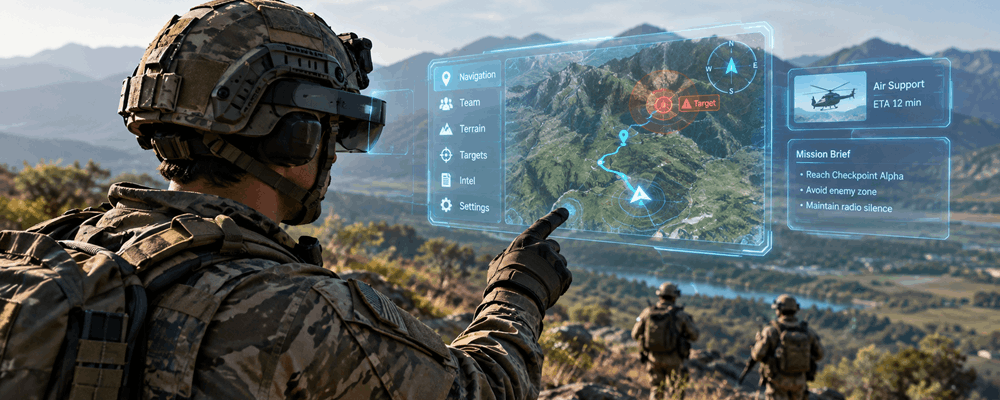
For example, an AR system could provide a soldier with a digital map or location-related information while the soldier continues observing the physical environment.
This could help reduce the need to constantly switch between different devices or look away from the surroundings.
For military organizations exploring AR for situational awareness, the goal is not simply to display more information. The real objective is to present the right information at the right time without overwhelming the user.
3. Supporting Navigation and Route Planning
Navigation can become challenging when soldiers operate in unfamiliar or difficult terrain.
AR-based navigation can combine location information with visual guidance. Instead of relying entirely on a separate map or navigation device, soldiers could potentially see directional information through an AR-enabled display.
Applications may include:
- Route guidance
- Landmark identification
- Terrain information
- Location markers
- Digital maps
- Waypoint information
- Unit positioning
This can make augmented reality navigation for military operations an interesting area for future development.
However, military navigation systems must be designed to work reliably in challenging environments and should not create additional distractions.
4. Transforming Equipment Maintenance
Military vehicles, communication systems, machinery, and other equipment can be highly complex. Maintaining them correctly requires trained personnel and detailed technical documentation.
AR can simplify maintenance by providing technicians with visual, step-by-step instructions while they work on physical equipment.
Imagine a technician inspecting a military vehicle. Instead of repeatedly checking a manual, an AR system could display digital instructions related to the component being inspected.
An AR maintenance solution could potentially provide:
- Component identification
- Maintenance instructions
- Repair procedures
- Assembly information
- Safety warnings
- Troubleshooting guidance
This approach is known as augmented reality maintenance and is already being explored across industrial sectors.
For armies, the same concept can help improve technical training and make complex maintenance procedures easier to understand.
5. Faster Skill Development for Soldiers
Military personnel need to develop practical skills through repeated training.
AR can create interactive learning experiences that allow soldiers to practice specific tasks multiple times.
For example, instead of simply reading how a particular piece of equipment works, a trainee could interact with a 3D representation of the equipment while receiving instructions.
This can be particularly useful when physical training equipment is expensive, unavailable, or difficult to transport.
AR can therefore support immersive military training while allowing instructors to create structured and repeatable learning experiences.
6. Improving Communication and Team Coordination
Communication plays a major role in ground operations.
AR technology can potentially support communication by presenting relevant information through wearable displays. Depending on the system architecture, soldiers could receive visual indicators, team-related information, or mission updates without constantly handling separate devices.
For example, an AR interface could help users understand the location of designated points or visualize information shared by another team member.
The key challenge is ensuring that information remains clear and useful. An overloaded AR interface could create confusion instead of improving coordination.
7. Supporting Vehicle and Machinery Training
Modern military vehicles and machinery can involve sophisticated controls and systems.
Training personnel on these systems can require specialized facilities and equipment. AR can supplement conventional training by overlaying digital instructions onto physical vehicle components.
A trainee could, for example, view information about a particular control, understand its function, and follow a simulated procedure before performing the task on actual equipment.
This can help organizations develop AR-based military training programs that combine physical practice with digital guidance.
8. Emergency and Medical Training
Another potential application of AR is emergency response and medical training.
Soldiers can encounter situations where first aid and emergency response skills are critical. AR can simulate scenarios that allow trainees to practice decision-making and procedures in a controlled environment.
Training scenarios could include:
- Emergency response
- First-aid procedures
- Evacuation exercises
- Equipment preparation
- Casualty response simulations
- Medical procedure training
Rather than replacing professional instruction, AR can act as an additional training layer that increases practice opportunities.
Key Benefits of Augmented Reality for Ground Army
The growing interest in AR in defense and military applications comes from several potential advantages.
- Better Training Experiences
AR makes training more interactive and can combine physical environments with digital simulations.
- Reduced Training Costs
Once developed, digital training content can potentially be reused across multiple training sessions and locations.
- Improved Knowledge Retention
Interactive visual learning can make complex procedures easier to understand and remember.
- Faster Access to Information
AR interfaces can provide relevant instructions or visual information without requiring users to constantly switch between physical manuals and devices.
- Safer Training
Certain high-risk situations can be simulated without exposing trainees to the same level of real-world danger.
- Better Equipment Understanding
3D models and visual instructions can help personnel understand complex machinery and technical systems.
- Scalable Training
Digital AR content can potentially be distributed across multiple training facilities and adapted for different scenarios.
- Challenges of Using AR in Military Operations
Despite its potential, implementing augmented reality for ground forces is not straightforward.
- Environmental Conditions
Military operations can take place in extreme heat, dust, rain, low visibility, and other challenging conditions. AR hardware needs to function reliably in such environments.
- Battery Life
Wearable AR devices depend on batteries. Long-duration missions require dependable power management.
- Information Overload
Too much information on a display can distract soldiers and negatively affect situational awareness.
- Cybersecurity
Military AR systems may process sensitive information. Strong cybersecurity and data protection are therefore essential.
- Connectivity
Some AR applications may depend on networks or external data. Systems designed for military environments need to account for situations where connectivity is limited or unavailable.
- Cost and Infrastructure
Developing advanced AR hardware, software, simulations, and training content can require significant investment.
The Future of Augmented Reality in the Army
The future of augmented reality in military applications is likely to involve greater integration between AR, artificial intelligence, sensors, digital twins, cloud computing, and advanced communication systems.
AI could help analyze information and deliver more relevant insights through AR interfaces. Digital twins could create detailed digital representations of vehicles, machinery, or training environments. Cloud technologies could support centralized management and distribution of training content.
Wearable devices are also expected to become smaller, lighter, and more capable.
The long-term objective is not simply to give soldiers futuristic glasses. It is to create technology that supports soldiers without becoming a distraction.
Successful military AR solutions will need to be practical, secure, reliable, comfortable, and easy to use in demanding environments.
Why AR Could Become an Important Military Technology
The biggest strength of augmented reality is its ability to connect digital information with the physical world.
For ground armies, this can create opportunities across training, maintenance, navigation, communication, equipment operation, and situational awareness.
Instead of separating digital learning from physical activity, AR can bring the two together. Soldiers can learn by interacting with realistic environments, technicians can receive visual maintenance guidance, and training teams can build more flexible simulation-based exercises.
As defense organizations continue investing in emerging technologies, AR could become an important part of the modern military technology ecosystem.
Conclusion
Augmented reality for ground army operations has the potential to transform how soldiers train, learn, maintain equipment, navigate environments, and access information. Its ability to combine digital content with real-world surroundings makes it particularly valuable for practical and immersive military applications.
However, successful adoption will depend on more than advanced hardware. Reliability, cybersecurity, usability, connectivity, battery life, and effective training content will all play important roles.
As AR continues to develop alongside AI, cloud computing, sensors, and other emerging technologies, its role in defense and military training is likely to expand. For ground forces, the future of AR may ultimately be one simple objective: helping soldiers make better-informed decisions, learn faster, and perform their responsibilities more effectively.