
How AR-Guided Maintenance Reduces Industrial Equipment Downtime
How AR-Guided Maintenance Reduces Industrial Equipment Downtime
Industrial equipment downtime can disrupt production schedules, increase maintenance costs, and affect overall operational efficiency. In manufacturing environments where complex machinery operates continuously, even a minor technical issue can create delays across an entire production line. Maintenance teams must identify problems quickly, follow the correct repair procedures, and restore equipment to working condition without compromising safety. Traditional maintenance methods often depend on printed manuals, technical documents, and the experience of skilled technicians. While these methods remain useful, they can become challenging when equipment is complex, maintenance procedures are lengthy, or experienced personnel are unavailable. This is where AR-guided maintenance can make a difference. By combining augmented reality (AR) with digital maintenance instructions and 3D visualizations, manufacturers can help technicians understand equipment, locate components, and follow repair procedures more efficiently. When implemented as part of a well-planned industrial maintenance strategy, AR can support faster troubleshooting, improve maintenance consistency, and help reduce avoidable equipment downtime.
What Is AR-Guided Maintenance?
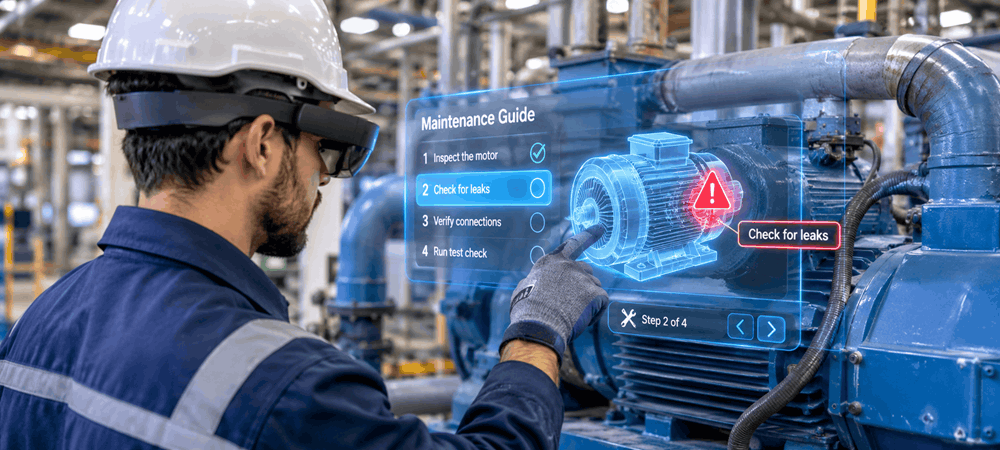
AR-guided maintenance uses augmented reality technology to display digital information over a technician’s view of real-world equipment. This information may include component labels, repair instructions, maintenance sequences, 3D models, safety warnings, and visual indicators.
Technicians can access these instructions through compatible smartphones, tablets, or augmented reality smart glasses, depending on the application and working environment.
For example, imagine a technician inspecting a complex industrial machine with several interconnected components. Instead of repeatedly checking a printed manual to identify a particular valve or assembly, the technician can use an AR application to view digital labels and step-by-step instructions associated with the equipment.
The objective is not to replace maintenance professionals. It is to give them relevant information at the point of work, helping them understand procedures and complete tasks with greater clarity.
For manufacturers managing multiple machines, production lines, or industrial facilities, this approach can become a valuable addition to their maintenance operations.
Why Industrial Equipment Downtime Remains a Major Challenge
Equipment downtime is not always caused by major mechanical failures. In many manufacturing environments, delays can also result from troubleshooting difficulties, incomplete maintenance documentation, incorrect component identification, or limited access to experienced technicians.
Several challenges contribute to maintenance inefficiencies.
1. Time-Consuming Troubleshooting
When a machine stops unexpectedly, technicians must determine the cause before deciding on the appropriate repair. Complex equipment may contain interconnected mechanical, electrical, and electronic systems, making fault identification difficult.
If technicians cannot quickly locate the relevant documentation or identify the affected component, troubleshooting may take longer than necessary.
AR-guided maintenance can help by displaying equipment information, component locations, and relevant diagnostic instructions directly within the technician’s view.
2. Dependence on Experienced Technicians
Manufacturing companies often rely on experienced maintenance professionals who understand specific machines and repair procedures. However, when these employees are unavailable, new or less experienced technicians may struggle to complete unfamiliar tasks.
AR applications can provide standardized visual guidance, helping technicians follow approved procedures without depending entirely on verbal instructions or individual experience.
Complex repairs may still require expert supervision, but accessible digital guidance can make routine maintenance easier to perform consistently.
3. Difficulty Following Technical Manuals
Traditional maintenance manuals can contain hundreds of pages of diagrams, specifications, and procedural instructions. Finding the correct information during an active repair can be inconvenient, especially when technicians need to understand how multiple components fit together.
AR simplifies access to relevant information by presenting instructions in a visual format. Rather than interpreting every step from a static diagram, technicians can view contextual guidance associated with the equipment they are servicing.
4. Inconsistent Maintenance Procedures
When different technicians follow different interpretations of the same procedure, maintenance quality can vary. Incorrect assembly, missed inspection steps, or incomplete servicing may contribute to equipment problems later.
AR-guided workflows can present approved instructions in a consistent sequence, helping maintenance teams follow standard operating procedures and complete required checks.
How AR-Guided Maintenance Helps Reduce Equipment Downtime
The value of augmented reality for industrial maintenance becomes clearer when it is applied to specific maintenance activities.
1. Faster Component Identification and Fault Location
Identifying the correct component is often an important first step in repairing complex machinery. Industrial equipment may contain multiple similar-looking parts, interconnected assemblies, and components positioned in difficult-to-access areas.
An AR maintenance application can overlay digital labels, markers, or 3D visualizations onto the equipment. These visual elements help technicians understand where a particular component is located and which parts may require inspection.
For example, during maintenance of a large industrial machine, a technician could use an AR interface to locate a specific assembly and view its associated inspection instructions.
This can reduce unnecessary searching and help technicians navigate equipment more confidently.
2. Step-by-Step Visual Repair Instructions
Maintenance procedures often involve several steps that must be completed in the correct order. A missed instruction or incorrect assembly sequence can lead to rework, additional inspections, or equipment damage.
AR-guided maintenance can break complex procedures into manageable stages. Technicians may see instructions for removing a component, inspecting specific parts, replacing a damaged element, and completing the necessary checks.
Interactive 3D models can also help explain component relationships that may be difficult to understand through text alone.
For manufacturers with standardized equipment and repeatable maintenance tasks, this approach can support more consistent repair practices and reduce avoidable procedural errors.
All instructions should be validated by qualified personnel and aligned with the manufacturer’s maintenance requirements and applicable safety procedures.
3. Remote Assistance From Maintenance Experts
Not every industrial facility has specialists available for every machine or technical problem. When an unfamiliar fault occurs, companies may need to wait for an experienced engineer or external service professional.
AR-enabled remote assistance can help connect on-site technicians with remote experts. Depending on the solution, the technician may share a live view of the equipment while the expert provides visual annotations, instructions, or other guidance.
For example, a technician working at a manufacturing facility could receive remote guidance to inspect a particular assembly or verify a repair step.
This can reduce delays associated with travel or repeated explanations and help companies make better use of their available technical expertise.
Remote assistance is especially relevant for manufacturers operating across multiple plants, service locations, or geographically distributed facilities.
4. Improved Preventive Maintenance Workflows
Preventive maintenance helps manufacturers identify potential equipment issues before they develop into more serious failures. However, its effectiveness depends on following inspection schedules and completing the required maintenance tasks correctly.
AR applications can guide technicians through scheduled inspections by displaying checklists, component locations, inspection points, and service instructions.
For example, during a routine inspection of industrial machinery, a technician could follow a visual checklist covering lubrication points, accessible connections, protective components, and other manufacturer-defined inspection requirements.
When integrated with suitable maintenance management systems, AR solutions may also support the recording of completed tasks and inspection findings.
These capabilities can help teams organize maintenance activities more consistently. AR does not independently predict failures unless it is connected to appropriate monitoring or diagnostic capabilities, but it can improve how technicians carry out maintenance procedures.
5. Better Maintenance Training and Knowledge Transfer
Training new maintenance technicians can be challenging when equipment is complex and practical experience is limited. Traditional training may require experienced employees to demonstrate procedures repeatedly, taking time away from other responsibilities.
AR-based training can provide interactive instructions that help employees become familiar with equipment, components, and maintenance sequences.
Technicians can use guided learning experiences to understand routine servicing procedures before performing them on operational machinery under appropriate supervision.
Digital maintenance instructions can also help preserve organizational knowledge by documenting approved procedures rather than leaving essential information dependent on individual employees.
For manufacturers facing skills shortages, AR can complement hands-on training and help create more consistent learning experiences across teams.
Real-World Industrial Use Cases of AR-Guided Maintenance
AR-guided maintenance can be adapted to different industrial environments depending on the equipment, operating conditions, and maintenance requirements.
Heavy Machinery Manufacturing
Heavy machinery manufacturers work with complex equipment containing numerous mechanical and hydraulic components. Identifying the correct part and following the appropriate servicing procedure can require detailed technical knowledge.
AR can help technicians visualize component locations, access repair instructions, and follow assembly or disassembly sequences. It can also support service teams working on machinery at customer locations.
Automotive Manufacturing
Automotive production lines rely on interconnected equipment, assembly stations, robotic systems, and specialized machinery. An equipment issue in one area can affect downstream operations.
AR-guided maintenance can help technicians locate components, follow inspection procedures, and access equipment-specific instructions during servicing.
The technology can also support standardized maintenance training across different production facilities.
Wind Energy and Power Equipment
Wind turbines and other power equipment may require maintenance in remote or challenging environments. Access to specialized technical support may not always be immediate.
Where suitable devices and connectivity are available, AR can provide visual maintenance guidance and facilitate remote collaboration between field technicians and experienced engineers.
Applications must account for environmental conditions, equipment accessibility, worker safety, and the technical limitations of the chosen AR hardware.
Industrial Equipment Servicing
Equipment manufacturers and service providers often need to support customers operating machinery across multiple locations.
AR-guided service applications can help technicians access digital manuals, understand equipment configurations, and follow approved troubleshooting procedures.
This can improve access to technical knowledge and support more consistent service delivery.
What Does It Take to Implement AR-Guided Maintenance?
Introducing augmented reality into industrial maintenance requires more than developing a visual application. The solution must fit existing equipment, maintenance workflows, and workforce requirements.
Manufacturers should consider the following factors before implementation.
1. Identify the right maintenance use case. Start with a specific challenge, such as locating complex components, guiding repetitive repairs, training new technicians, or supporting remote assistance.
2. Select suitable AR hardware. Smartphones, tablets, and smart glasses offer different capabilities. The choice should depend on the work environment, hands-free requirements, visibility, durability, and safety considerations.
3. Develop accurate digital content. Maintenance instructions, 3D models, component labels, and visual overlays must match the actual equipment and approved procedures.
4. Integrate with existing systems where necessary. Depending on business requirements, the application may connect with computerized maintenance management systems (CMMS), enterprise asset management platforms, equipment databases, or industrial IoT systems.
5. Train employees and test the workflow. Technicians should be able to navigate the application comfortably. Pilot testing can reveal usability issues and help validate whether the solution addresses the original maintenance challenge.
6. Measure operational outcomes. Track relevant indicators such as mean time to repair (MTTR), equipment downtime, maintenance task completion time, repeat faults, and adherence to maintenance procedures. Compare results against an appropriate baseline before making broader performance claims.
A focused implementation allows manufacturers to evaluate practical value before expanding AR across multiple facilities or equipment categories.
Challenges to Consider Before Adopting AR Maintenance Solutions
Although AR offers several opportunities, manufacturers should also understand its limitations.
Developing accurate digital assets can require time and technical expertise, particularly when equipment documentation is incomplete. AR applications may also need updates when machinery or maintenance procedures change.
Connectivity, lighting, device compatibility, and environmental conditions can affect usability. Some maintenance environments may not be suitable for certain wearable devices, and AR must never distract technicians from hazards or replace required lockout/tagout procedures, personal protective equipment, or other safety controls.
Integration with existing systems can introduce additional complexity, particularly when different facilities use different equipment databases or maintenance platforms.
A successful implementation therefore requires collaboration between maintenance specialists, IT teams, safety professionals, and XR developers.
The Future of AR-Guided Industrial Maintenance
As manufacturing operations become increasingly connected, augmented reality can play a growing role in delivering technical information where and when workers need it.
When combined with industrial IoT platforms, equipment monitoring systems, and suitable AI-powered diagnostic tools, AR applications may help technicians access relevant equipment data, understand reported faults, and follow recommended maintenance workflows.
For example, an equipment monitoring system could identify an abnormal operating condition and provide information to a maintenance platform. An AR application could then help a technician locate the relevant component and follow an approved inspection procedure.
Such workflows depend on reliable data, appropriate integrations, and validated technical recommendations. AR provides the visual guidance layer; connected systems and diagnostic technologies provide additional information when available.
For manufacturers, the opportunity is to create maintenance processes that are easier to follow, more consistent, and better supported by digital tools.
Conclusion
Industrial equipment downtime can affect productivity, operating costs, and delivery schedules. Although not every equipment failure can be prevented, improving maintenance workflows can help manufacturers respond to problems more effectively.
AR-guided maintenance offers a practical way to support technicians with visual instructions, component identification, remote expert assistance, preventive maintenance guidance, and technical training. By making relevant information easier to access at the point of work, manufacturers can help maintenance teams perform their tasks with greater clarity and consistency.
At Sapizon Technologies, custom XR development can support businesses looking to explore augmented reality applications for industrial maintenance, workforce training, and equipment servicing. The right solution begins with understanding the equipment, identifying the maintenance challenge, and developing an application that fits the actual working environment.
Looking to explore AR-guided maintenance for your industrial operations? Contact Sapizon Technologies to discuss how a custom XR solution could support your maintenance and workforce training requirements.