
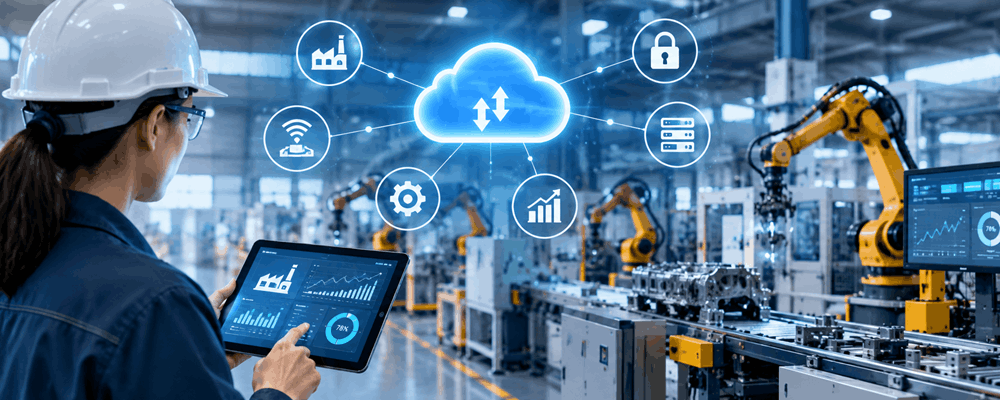
How Cloud Computing Supports Industrial IoT and Smart Factories
How Cloud Computing Supports Industrial IoT and Smart Factories
Manufacturing is becoming more connected, data-driven, and intelligent. Machines, sensors, production lines, and enterprise systems are generating enormous amounts of data every day. But collecting this data is only the beginning. Manufacturers need a reliable way to store, process, analyze, and act on it. This is where cloud computing and Industrial IoT (IIoT) come together.
Cloud computing provides the scalable infrastructure needed to manage industrial data, while Industrial IoT connects machines, sensors, equipment, and factory systems to collect real-time information. Together, these technologies help manufacturers build smart factories that can monitor operations, identify problems, improve production efficiency, and support better decision-making.
Modern manufacturing environments can contain thousands of sensors and connected devices, generating information about machine conditions, production processes, energy consumption, and product quality. Cloud-based platforms can bring this information together and make it available for analytics, monitoring, and intelligent applications.
But what does this look like in a real factory? And how exactly does cloud computing support Industrial IoT and smart manufacturing?
Let’s explore.
What Is Industrial IoT Manufacturing?
Industrial IoT refers to the use of connected sensors, machines, equipment, and industrial systems to collect and exchange operational data.
Unlike consumer IoT devices such as smart watches or home assistants, IIoT focuses on industrial environments such as manufacturing plants, automotive facilities, warehouses, energy plants, and other production environments.
A typical IIoT setup can collect information such as:
- Machine temperature
- Vibration levels
- Production speed
- Equipment utilization
- Energy consumption
- Pressure and humidity
- Production output
- Quality measurements
- Machine operating status
This data can then be analyzed to identify patterns, detect unusual behavior, monitor production, and support maintenance decisions.
However, connecting machines is not enough. Manufacturers also need an infrastructure capable of handling the large volume of information generated across their facilities. This is one of the areas where cloud computing is important.
How Do Cloud Computing and Industrial IoT Work Together?
Industrial IoT devices generate data on the factory floor. Edge devices or gateways can collect and process this information before securely sending relevant data to cloud platforms.
Once the data reaches the cloud, it can be stored, organized, analyzed, and connected with other business systems.
A simplified cloud-based IIoT workflow looks like this:
Machines and sensors → Edge devices → Cloud platform → Data storage → Analytics and AI → Business insights → Action
For example, imagine a manufacturing machine equipped with vibration sensors. The sensors continuously monitor the machine. If vibration levels begin to move outside their normal range, the data can be analyzed to identify a possible equipment problem.
Instead of waiting for the machine to fail, maintenance teams can receive an alert and investigate the issue.
Cloud platforms also make it easier to connect factory-floor data with systems such as Manufacturing Execution Systems (MES), Enterprise Resource Planning (ERP), analytics platforms, and other enterprise applications.
This creates a more connected manufacturing environment where operational data can support business decisions.
1. Real-Time Production Monitoring
One of the most practical applications of cloud computing in manufacturing is real-time production monitoring.
Traditional production monitoring can depend heavily on manual data collection and isolated systems. This can make it difficult for managers to understand what is happening across multiple production lines or facilities.
With Industrial IoT, machines and sensors can continuously send operational data to a centralized cloud environment.
Manufacturing teams can use dashboards to monitor:
- Production output
- Machine availability
- Downtime
- Production cycle times
- Equipment performance
- Quality indicators
- Energy usage
This gives decision-makers greater visibility into factory operations.
For manufacturers operating multiple plants, cloud infrastructure can also provide a centralized way to access and analyze information from different locations.
2. Predictive Maintenance
Unexpected equipment failure can interrupt production and create significant operational challenges.
Predictive maintenance uses machine and sensor data to identify signs that equipment may require attention before a major failure occurs.
For example, sensors can monitor vibration, temperature, pressure, or other machine conditions. Cloud-based analytics and machine learning models can examine historical and real-time data to identify unusual patterns.
If a machine begins showing behavior associated with previous failures, the system can alert the maintenance team.
This allows organizations to move from a purely reactive maintenance approach toward a more proactive one.
Cloud-based predictive maintenance is particularly useful when manufacturers have large numbers of machines across multiple facilities because data can be collected and analyzed at scale. Microsoft, AWS, and other technology providers describe predictive maintenance as a key smart manufacturing use case combining industrial data, cloud infrastructure, analytics, and AI.
3. Improved Quality Control
Product quality depends on consistent manufacturing processes.
Industrial IoT can continuously collect data from machines, production lines, sensors, and inspection systems. Cloud platforms can then bring this information together for analysis.
For example, if a particular production parameter repeatedly changes before defective products appear, manufacturers can investigate the relationship between the process variable and product quality.
Cloud-based systems can also support AI-powered visual inspection. Cameras can capture images of products while computer vision models analyze them for potential defects.
This can help manufacturers detect quality issues earlier and understand their root causes.
The combination of IoT, cloud computing, analytics, and AI are increasingly being used for quality inspection, anomaly detection, root-cause analysis, and process optimization.
4. Energy Monitoring and Optimization
Energy consumption is another area where Industrial IoT and cloud computing can provide valuable insights.
Manufacturing facilities use energy across machines, HVAC systems, compressors, lighting, heating systems, and other equipment.
IoT sensors can collect energy-related information from different parts of a facility. Cloud platforms can then aggregate this information and make it easier to identify unusual consumption patterns.
For example, if one production line consistently consumes more energy than comparable lines, managers can investigate the reason.
Over time, organizations can use this information to optimize equipment operation, identify inefficiencies, and support their sustainability initiatives.
5. Connecting Multiple Manufacturing Locations
Large manufacturers may operate several plants across different cities or countries. Each facility may have different machines, production systems, and data sources.
Without a connected architecture, information can remain isolated within individual plants.
Cloud computing can provide a common infrastructure for collecting and analyzing data across multiple locations.
This creates opportunities for organizations to compare production performance, identify recurring problems, share operational insights, and establish standardized monitoring practices.
A centralized cloud architecture can also support enterprise-wide analytics without requiring every facility to maintain identical infrastructure locally.
6. Supporting Digital Twins
Digital twins are another important application of cloud computing and Industrial IoT.
A digital twin is a digital representation of a physical asset, process, or environment that can use real-world data to reflect its current condition or behavior.
In manufacturing, a digital twin can represent:
- A machine
- A production line
- A factory
- A manufacturing process
- A product
IIoT devices provide real-world data, while cloud platforms can provide the computing and data infrastructure needed to manage and analyze that information.
Manufacturers can use digital twins for production monitoring, simulation, process optimization, and maintenance-related applications.
This can help engineering and operations teams understand how changes to a process or asset may affect performance before implementing them in the physical environment.
7. Remote Equipment Monitoring
Cloud-connected Industrial IoT can also make remote monitoring possible.
Instead of requiring engineers or managers to be physically present at every machine or facility, authorized users can access relevant operational information through centralized dashboards.
This can be particularly useful for organizations with geographically distributed manufacturing facilities or equipment installed at customer locations.
Remote monitoring can help teams identify potential issues earlier and coordinate maintenance activities more efficiently.
However, remote access must be designed with appropriate cybersecurity controls. Industrial environments connect operational technology with IT systems, so manufacturers need to consider identity management, device security, network protection, data governance, and monitoring as part of their cloud and IIoT strategy.
8. Better Data-Driven Decision Making
Perhaps the biggest advantage of combining cloud computing with Industrial IoT is the ability to turn large volumes of operational data into useful business information.
A factory may generate huge amounts of raw data every day. Without proper infrastructure, that data can remain fragmented or underutilized.
Cloud platforms can provide scalable storage and computing resources for processing this information.
Manufacturing leaders can use analytics dashboards to answer questions such as:
- Which machines are experiencing the most downtime?
- Which production lines are performing below target?
- Where are quality problems occurring?
- Which assets require maintenance?
- How is energy being consumed?
- Are similar issues appearing across multiple facilities?
Instead of relying entirely on assumptions or manually collected reports, teams can use current operational data to support decisions.
Cloud and Edge Computing: Why Both Matter
Cloud computing does not mean that every piece of data must travel directly from a machine to a distant cloud server.
In many industrial environments, edge computing works alongside cloud infrastructure.
Edge devices can process certain information closer to where it is generated. This is useful when applications require fast response times or when sending every piece of raw data to the cloud would be inefficient.
The cloud can then be used for larger-scale storage, analytics, machine learning, centralized management, and cross-site insights.
This combination of edge and cloud computing is increasingly important for smart factories because it balances local responsiveness with centralized intelligence. AWS and Microsoft both describe architectures that combine factory-floor or edge processing with cloud services for industrial IoT and manufacturing workloads.
Challenges of Implementing Cloud-Based IIoT
Although cloud computing can offer significant advantages, implementing Industrial IoT is not simply a matter of connecting machines to the internet.
Manufacturers may need to deal with:
- Legacy equipment and machines
- Different industrial communication protocols
- Data integration challenges
- Cybersecurity requirements
- Network reliability
- Data governance
- Workforce training
- Integration with existing ERP and MES systems
- Initial implementation costs
Older machines may not have built-in connectivity, which means additional gateways or sensors may be required.
Manufacturers also need a clear architecture that defines what data should be collected, where it should be processed, how it should be secured, and how it will ultimately support business objectives.
A phased approach can help organizations start with a specific use case, validate its value, and then expand the architecture to additional machines, production lines, or facilities.
The Future of Cloud Computing and Smart Factories
The relationship between cloud computing, Industrial IoT, artificial intelligence, and smart manufacturing is likely to become increasingly interconnected.
Manufacturers are moving beyond simply collecting machine data. They are looking at how that data can support predictive maintenance, automated quality inspection, process optimization, digital twins, AI-assisted operations, and more intelligent decision-making.
Recent manufacturing architectures increasingly combine IoT, edge computing, cloud platforms, AI, analytics, and enterprise systems into a connected technology ecosystem.
The goal is not to make a factory “smart” simply by adding more connected devices. The real objective is to create a manufacturing environment where data can move securely from machines to the people and systems that need it, helping organizations respond faster and operate more efficiently.
Conclusion
Cloud computing is becoming an important foundation for Industrial IoT and smart manufacturing. By providing scalable infrastructure for storing, processing, and analyzing industrial data, the cloud can help manufacturers connect machines, monitor production, support predictive maintenance, improve quality control, optimize energy consumption, and gain visibility across facilities.
When combined with edge computing, AI, machine learning, and Industrial IoT, cloud technology can help manufacturers move toward more connected and data-driven operations.
For organizations planning their smart factory journey, the most important step is not adopting every available technology at once. It is identifying the operational problems that matter most and building a practical technology strategy around them.
At Sapizon Technologies, we help businesses explore technology solutions that support modern digital transformation, including cloud services and industrial technology solutions. With the right combination of cloud infrastructure, connected systems, analytics, and intelligent technologies, manufacturers can build a stronger foundation for the next generation of industrial operations.