
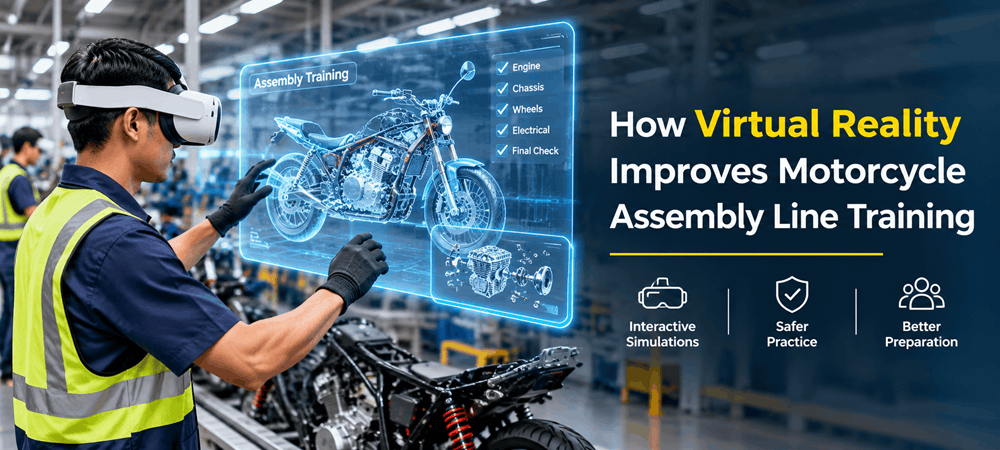
How Virtual Reality Improves Motorcycle Assembly Line Training
How Virtual Reality Improves Motorcycle Assembly Line Training
The motorcycle manufacturing industry is constantly evolving, with manufacturers looking for better ways to improve production quality, reduce assembly errors, and train employees more effectively. However, training workers to handle complex assembly processes remains a challenge. Virtual Reality in motorcycle manufacturing offers a practical solution by allowing employees to learn and practice assembly procedures in a realistic virtual environment before working on actual production lines. From engine installation to electrical wiring and final quality inspection, VR-based training helps workers understand each step while building confidence and technical skills.
Understanding the Challenges of Motorcycle Assembly Line Training
Motorcycle assembly involves several interconnected processes. Each component, whether it is the engine, transmission, braking system, suspension, or electrical wiring, must be installed correctly to ensure the vehicle meets quality and safety standards.
For new employees, understanding these procedures can take time. Traditional training methods generally involve classroom instructions, demonstrations, printed manuals, and hands-on practice under supervision.
Although these methods are useful, they also come with certain limitations:
- Limited practical experience: Employees may understand the instructions but struggle when performing tasks on actual components.
- Risk of assembly mistakes: Incorrect installation or handling can affect product quality and lead to rework.
- Training interruptions: Practicing active production lines can sometimes interrupt regular manufacturing activities.
- Equipment-related risks: Inexperienced workers may face safety risks when learning to operate industrial machinery.
- Inconsistent training: Different trainers may explain the same assembly procedure in different ways.
These challenges make it important for motorcycle manufacturers to explore more interactive and effective employee training methods.
What Is Virtual Reality in Motorcycle Manufacturing?
Virtual Reality (VR) is a technology that creates an interactive, computer-generated environment that users can explore using a VR headset and compatible controllers.
In motorcycle manufacturing, VR can recreate an assembly workstation, production line, engine assembly area, or an entire factory environment. Employees can enter this virtual space and learn how different manufacturing operations work.
For example, instead of learning engine assembly only through printed instructions, a trainee can enter a virtual workshop, identify individual engine components, understand their functions, and practice placing them in the correct positions.
The system can provide visual instructions, interactive demonstrations, and feedback when a user performs an incorrect step.
This makes VR training for automotive manufacturing more practical because employees can learn by doing rather than simply watching or reading instructions.
6 Ways Virtual Reality Improves Motorcycle Assembly Line Training
1. Provides Hands-On Assembly Practice Without Physical Components
One of the biggest advantages of VR is that employees can practice assembly procedures in a simulated environment without requiring actual motorcycle components for every training session.
Consider a worker learning how to assemble a motorcycle engine. The process involves several parts, including the cylinder, crankshaft, piston, valves, and other components.
Using a VR simulation, the employee can:
- Identify different engine components.
- Understand where each component belongs.
- Follow the correct assembly sequence.
- Practice positioning and fitting components.
- Repeat the process until they understand the procedure.
If the employee makes a mistake, the simulation can provide immediate feedback and guide them toward the correct step.
This type of virtual assembly training helps employees develop familiarity with complex procedures before moving to real production work.
2. Helps Employees Learn Complex Assembly Procedures
Motorcycles contain several components that require accurate positioning and proper installation. Even a small mistake during assembly can affect the performance, reliability, or safety of the finished vehicle.
VR makes it easier to explain these complicated procedures through interactive 3D models.
For example, when training employees to install a motorcycle braking system, the simulation can display the brake disc, caliper, brake pads, and connecting components separately.
Employees can explore how these parts fit together and follow the correct installation sequence.
Similarly, VR can be used to train workers in:
- Motorcycle engine assembly.
- Suspension system installation.
- Handlebar and control fitting.
- Electrical wiring connections.
- Fuel system assembly.
- Wheel and tyre installation.
By allowing employees to understand individual components and their relationships, VR helps make technical training easier to follow.
3. Improves Workplace Safety Through Virtual Training
Safety is an important concern in every motorcycle manufacturing facility. Assembly line workers regularly interact with machinery, lifting equipment, electrical systems, welding stations, and moving production equipment.
Training inexperienced employees directly on operational equipment can involve unnecessary risks.
VR-based safety training allows employees to experience simulated workplace situations without exposing them to actual hazards.
For instance, a trainee can explore a virtual motorcycle production facility and learn how to:
- Identify potentially dangerous areas.
- Follow machinery operating procedures.
- Maintain safe distances from moving equipment.
- Respond to simulated workplace emergencies.
- Follow personal protective equipment requirements.
Manufacturers can also create scenario-based training where employees learn how to respond to unexpected situations.
This approach gives workers an opportunity to understand safety procedures and practice their responses in a controlled environment.
4. Makes Training Consistent Across Different Production Shifts
Motorcycle manufacturing facilities often operate across multiple shifts, with different employees and supervisors handling production activities.
Maintaining consistent training quality across all shifts can be challenging.
With VR training, manufacturers can create standardized learning modules based on their actual assembly procedures.
Every employee can access the same virtual workstation, instructions, component models, and practice activities.
For example, if a manufacturer introduces a new motorcycle model, the company can develop a VR training module explaining its updated assembly process.
Employees across different shifts can use the same simulation to understand the new procedures.
This helps maintain consistency in training and reduces dependency on repeated physical demonstrations.
5. Helps Workers Understand Quality Inspection Procedures
Quality inspection is another important stage of motorcycle manufacturing. Every vehicle must pass several checks before it reaches the customer.
Workers need to understand how to identify incorrect installations, missing components, loose connections, and other assembly-related issues.
VR simulations can help employees learn these inspection procedures through interactive scenarios.
A virtual training module can present a motorcycle model with different simulated assembly defects. Employees must examine the vehicle, identify potential problems, and select the appropriate corrective action.
For example, training scenarios can cover:
- Incorrect component positioning.
- Improper wiring connections.
- Missing fasteners.
- Incorrect brake component installation.
- Visible assembly defects.
By practicing these situations, employees can become more familiar with inspection checkpoints and understand why attention to detail matters.
VR supports inspection training, although it does not replace actual physical quality testing and inspection equipment.
6. Reduces Dependence on Physical Training Resources
Traditional manufacturing training often requires physical components, dedicated workstations, tools, and trainer supervision.
For frequently repeated training sessions, these resources can increase training costs and place additional demands on production facilities.
VR offers an additional training environment where employees can repeat selected procedures without consuming physical components during every practice session.
Manufacturers can also update digital training modules when assembly procedures change, rather than rebuilding every training demonstration from the beginning.
Over time, this can make certain parts of employee training easier to organize and manage.
Actual cost savings depend on the initial VR development investment, hardware requirements, maintenance, and the number of employees using the system.
Real-World Example: Training Employees to Assemble a Motorcycle Engine Using VR
To understand how this technology works in practice, consider a motorcycle manufacturer introducing a new engine assembly process.
The company needs to train 30 new employees before they begin working on the production line.
With traditional training, each employee may need physical demonstrations, trainer supervision, and repeated practice with actual engine components.
A VR-based training program can provide an additional learning environment.
Step 1: Enter the virtual workshop
Employees wear a VR headset and enter a simulated motorcycle engine assembly workstation.
Step 2: Understand the components
The system displays a 3D engine model. Trainees can explore different components, zoom in, and understand how individual parts fit together.
Step 3: Follow assembly instructions
The simulation guides employees through the assembly sequence, showing where each component needs to be positioned.
Step 4: Practice independently
Employees repeat the assembly process and learn to complete each step correctly. The system can highlight incorrect actions and provide guidance.
Step 5: Evaluate performance
The training program can record selected performance indicators, such as task completion, incorrect actions, and time taken, depending on its design.
Step 6: Move to practical training
After completing the virtual module, employees can move to supervised hands-on training using real components and equipment.
This combination of VR and practical training can help employees become more familiar with assembly procedures before entering the actual production environment.
VR and the Future of Motorcycle Manufacturing
The motorcycle manufacturing industry is moving towards smarter and more connected production environments. Technologies such as Artificial Intelligence (AI), Digital Twins, Augmented Reality (AR), and Virtual Reality (VR) are creating new opportunities for manufacturers.
In the coming years, VR could become an important part of workforce development and manufacturing process planning.
For example, manufacturers could use virtual factory environments to train employees before introducing new production lines. Digital representations of motorcycle components could help teams understand complex assembly procedures. VR simulations could also support training for electric motorcycle production, where employees need to understand battery systems, electric motors, and high-voltage safety procedures.
As motorcycle designs and manufacturing processes become more advanced, interactive training solutions can help companies prepare their workforce for changing production requirements.
Why Motorcycle Manufacturers Should Consider VR-Based Training
VR is not simply about creating an impressive virtual environment. Its real value comes from solving practical manufacturing challenges.
For motorcycle manufacturers, VR-based training can offer several advantages:
- Better employee preparation: Workers can become familiar with assembly procedures before handling real components.
- Improved learning experience: Interactive 3D environments make complex instructions easier to understand.
- Safer practice: Employees can explore simulated workplace hazards without exposure to real operational risks.
- Standardized training: Different teams can follow the same digital training modules.
- Flexible learning: Employees can repeat training exercises whenever additional practice is required.
- Easier process updates: Digital training modules can be modified when manufacturing procedures change.
However, VR works best as part of a complete training program. Employees still need supervised practical experience, real equipment handling, and actual quality assessments.
Conclusion
Training employees for motorcycle assembly line operations requires time, practical knowledge, and consistent guidance. As manufacturing processes become more complex, traditional training methods alone may not always provide the level of interactive learning that modern production environments require.
Virtual Reality in motorcycle manufacturing creates an opportunity for employees to practice assembly procedures, understand complex components, improve safety awareness, and become familiar with production workflows in a simulated environment.
For manufacturers looking to modernize their workforce training, VR can be a valuable addition to existing learning methods.
At Sapizon Technologies, we develop customized AR/VR solutions designed to address real-world industrial challenges. From immersive assembly training to interactive manufacturing simulations, our solutions can help businesses explore new ways to train their workforce and improve operational readiness.
Looking to introduce VR-based training into your manufacturing operations?
Contact Sapizon Technologies to explore customized Virtual Reality solutions for your industrial requirements.